The Reason For Experimental TV, Involved Consumer Protections…
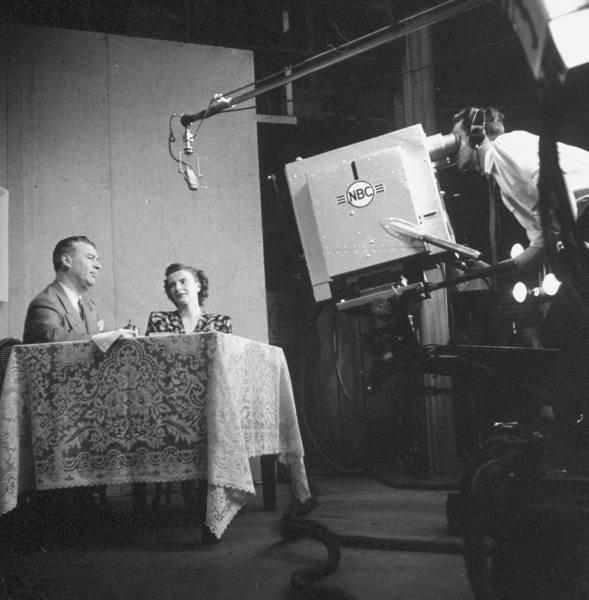
On July 1, 1941, the era of commercial television began in the US, when NBC’s W2XBS became WNBT and CBS’s W2XAB became WCBW. (Until 1946, network flagship radio, or television stations could not be named after the network).
It may surprise you to know that during the experimental period, the amount, and content of newspaper and magazine advertising by television equipment makers was closely controlled by the FCC, but they had a good reason.
The FCC felt that there was too much difference in the way many companies wanted to push forward, and to keep the public from buying a set that could be obsolete in just a few years, they had to kept a lid on the influence these manufacturers had, via their advertising. It worked.
For instance, RCA wanted to keep the 441 lines scanned per second system they had been using, but Dumont and Philco wanted 600 to 800 lines of resolution.
While trying to throttle back ad claims, the FCC created the NTSC, or National Television Standards Committee, which was made up of members from all the companies. It was their job to settle, for once and for all, just what the standards would be. In March of 1941, they issued their report which which set the standard of 525 lines of resolution, with 30 frames per second, an aspect ratio of 4:3 and audio transmitted via FM.
While we are on the subject of consumer protection, this is the perfect place to take up the importance of the “compatible color” issues that faced the industry, and involved similar problems as the committee had faced with black and white television.
In January 1950, the NTSC was reconstituted to standardize color television. CBS had the mechanical wheel, Field Sequential System, and RCA had the all electronic Dot Sequential System, and as you know, there was a huge fight, and decisions from the courts.
In December 1953, the NTSC unanimously approved what is now called the NTSC color television standard, which is based on the RCA Dot Sequential System. The “compatible color” standard retained full backward compatibility with existing black-and-white television sets, with color information added to the black and white image by introducing a color subcarrier.
As we get closer to July 1, we’ll take a look at more of the history surrounding this giant step in television. Enjoy and share. -Bobby Ellerbee
i love this stuff
Always wondered why flagship calls were different. CBS RADIO NY began as WABC — Atlantic Broadcasting, in repeated to today’s ABC.
Great information, Bobby. Thanks!
Well, not exactly “full” compatibility – it eventually birthed the monster known as drop-frame time code.
If it hadn’t been for the NTSC TV could have wound up like AM Stereo! And we know well that turned out.
Why did they let the consumer battle out beta max and vhs? Not that it matters today.
Wow, back when regulation was on the side of the consumer.
Adams Hat Co. An early advertiser on commercial TV. 1941 NBC/WNBT photo.
Of course, the FCC originally set the CBS system as the standard. It was a classic case of “be careful what you wish for.” Every program CBS broadcast in color was a program unaccessible to viewers with black and white sets. And no other manufacturer was committed to building the finicky receivers for the CBS system. With no obvious solution to this problem in sight, William Paley asked the Defense Department to order the production of color television equipment embargoed for the duration of the Korean War, and thus got CBS off the hook.
I love this FB page. As a teacher of Audio/video, it’s nice to review the history of how our technology and craft developed.
Was that call letter rule really an FCC requirement ir just tradition?
Back in the mid 90s I had a Producer from the UK tell me that NTSC stood for never twice the same color.
NTSC = Never Twice the Same Color. 🙂