45 Years Ago Today…Apollo 11 On The Way Home: Day 8
45 Years Ago Today…Apollo 11 On The Way Home: Day 8
Here is the eighth of nine daily articles written for Eyes Of A Generation by Jodie Peeler on this historic event, complete with videos. Enjoy and share!
______________________________________________________
Apollo 11’s Television Cameras:
As discussed in yesterday’s post, television cameras were carried by the Apollo spacecraft starting with the first manned mission in October 1968. Here’s the story of the television cameras that made it possible for viewers at home to watch what was going on in space.
Apollo 7 and Apollo 8 carried a small black-and-white slow-scan camera developed by RCA. Designed to operate within the limited bandwidth available for television downlink at the time, the RCA camera had a 320-line progressive scan format at 10 frames per second, and had a one-inch vidicon tube. As described yesterday, the television pictures sent back by the spacecraft were converted on Earth before being sent to NASA and then to the networks. Although more advanced capabilities were available by October 1968, NASA flew the RCA camera because it was already flight-qualified.
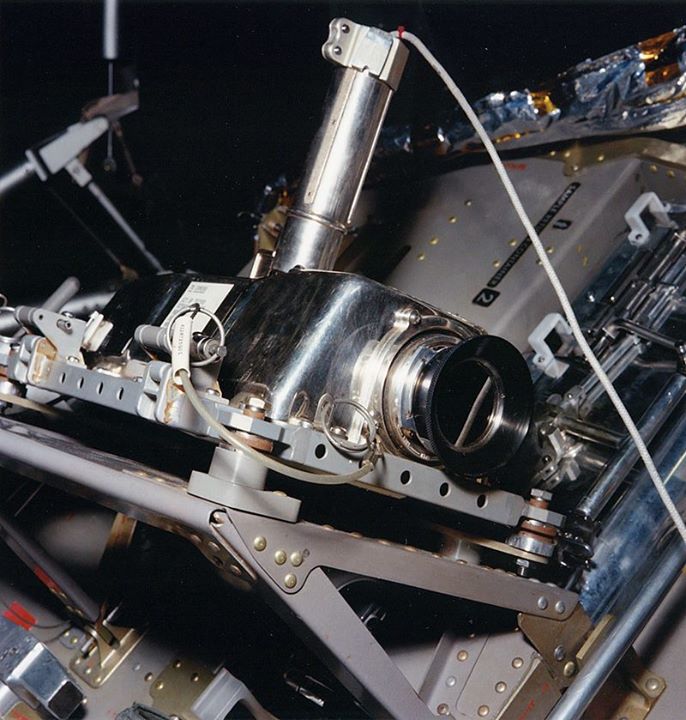
On Apollo 9, the first manned flight of the lunar module took place in Earth orbit. The LM would require its own camera, and a Westinghouse team led by Stan Lebar developed a slow-scan black-and-white video camera for the LM. It used a very sensitive secondary electron conduction tube unlike any other tube readily available, meant to provide detail from what was likely to be a dark and shadowy lunar surface. Although on landing missions it would ride in a compartment on the LM’s descent stage, it was carried in the cabin on Apollo 9 so the astronauts could test it out.
For television historians, the most intriguing camera made its debut on Apollo 10, the first flight to send color television from space.
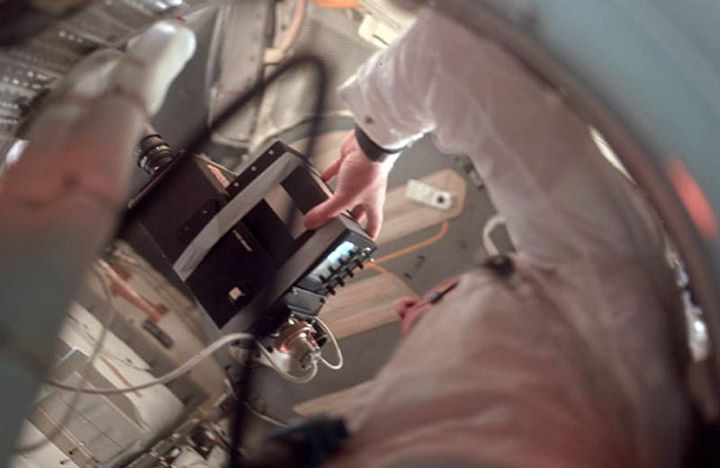
Westinghouse realized that a mechanical color system similar to that championed by CBS during the “color war” of the late ’40s, was not much more complicated than black-and-white and could be kept far more compact than a full-blown color system. The problem of conversion to NTSC was taken care of with conversion equipment installed in Houston. So, in a way, CBS had the last laugh as field-sequential color pictures sent back the first color television pictures of Earth in May 1969.
One problem with earlier Apollo television transmissions was that the astronauts had no viewfinder or monitor, so Westinghouse developed a small black-and-white monitor that could be secured atop the camera to let them see what they were shooting.
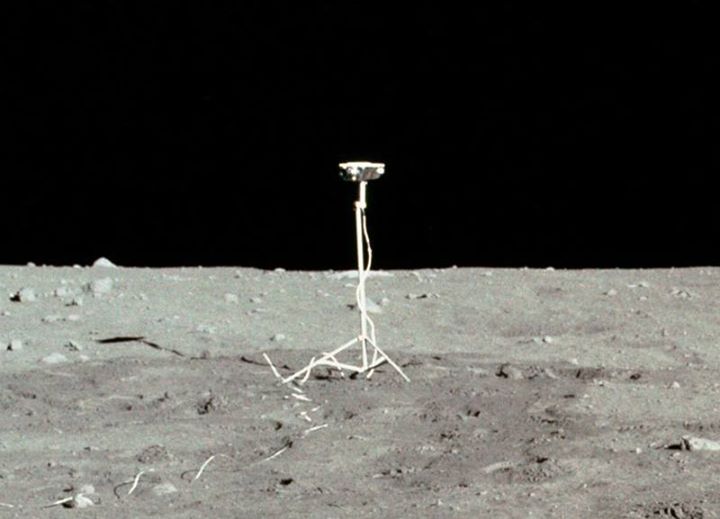
The two camera systems developed by Westinghouse – the color unit in the Command Module, and the black-and-white unit attached to the LM – flew with Apollo 11 two months later. Color television came from inside the spacecraft at several points during the mission. When Neil Armstrong emerged from Eagle on July 20 to begin his climb down to the Moon, a compartment on Eagle’s descent stage opened, allowing the black-and-white lunar camera to capture his first steps. Once he was on the Moon, he removed the camera from its platform and placed it on a tripod a few yards from the LM. It captured all of Armstrong and Aldrin’s historic Moon walk, and still stands where they left it in July 1969.
Later cameras improved on these innovations – the color camera was adapted for lunar use by the Apollo 12 flight in November 1969, and in time for Apollo 15 RCA designed a sophisticated color camera mounted on the Lunar Rover that could be controlled from Houston, a system that sent back some of the most vivid moving pictures of the entire Apollo program. However, it’s those two Westinghouse cameras from Apollo 11 that captured the eight days when mankind made its most dramatic step into the future.
For more information on the Apollo cameras, try these links.
Stan Lebar’s memories of developing the Westinghouse lunar camera:
http://www.tvtechnology.com/feature-box/0124/tvs-longest-remote/202657
Bill Wood’s epic “Apollo Television” essay features information about all the cameras of Apollo:
http://www.hq.nasa.gov/alsj/ApolloTV-Acrobat5.pdf
Tomorrow: Our look at Apollo 11 ends as Armstrong, Aldrin and Collins take a fiery ride home, and television brings the story’s conclusion to a watching world.
What an excellent, well-researched, informative, and timely piece — even to this “expert.” I somehow missed the earlier essays in this Apollo 11 series by Professor Peeler, but will now seek them out PDQ! She did a fine job here. As always, of course, I will advocate for SI/modernized metric measurements and logical-order dates, of course. 🙂
Other than that, two key points I would add are the strange reticence/hostility of some in 1960s NASA to TV cameras aboard human (manned being the term back then) space missions, including the Apollo 7 crew commanded by Wally Schirra, and various ground-bound engineers and officials. From multiple perspectives — real-time science and engineering data, Mission Control/MOCR, current crew debriefing, training of future crews, historical record, journalististic coverage, public awareness and involvement and support, et cetera — TV cameras made total sense to add to the manifests. Granted, some technical challenges existed, and TV would add to extensive in-flight crew duties. But the rewards would be simply splendid.
Also, MC Tom Stafford of Apollo 10 deserves great credit for successfully championing color television for that mission, against the technical odds and resistant bureaucracy. He is a real hero for that reason, often underappreciated, plus of course a hero for international space cooperation in ASTP, and much else.
Which flight was it where the astronaut aimed the camera directly at the sun and burned the tube? Or did a UFO cause that?
Do me a Favour !
Full scale model of the Westinghouse B&W TV camera. The two TV cameras displayed in the cabinet are mislabeled.
Full scale model of Westinghouse color camera. Picture taken at the Neil Armstrong Air & Space Museum.