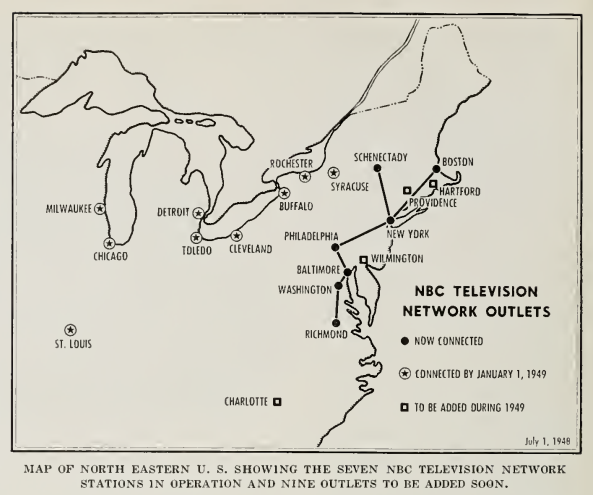
NBC Television Network: July 1, 1948
For a bit of perspective on how much things have changed, here is a map of NBC’s network in the middle of 1948. At the time, there were only seven stations, with nine to be added in 1949.
Of course the NBC Radio network was much bigger and was coast to coast, but AT&T was the driving force in where and when television could go. TV took coaxial cables or microwave relays and all that had to be built or laid. Enjoy and share! -Bobby Ellerbee
I like the way they’ve mis-identified Hartford and Providence!
WSB in Atlanta began in 1948 as an NBC affiliate, yet they were not yet connected to the network. I wonder how they received their NBC programming?
So was Cincinnati in 1948 with NBC. I guess they used either Microwave Relay or a Medium (as is Psychic)!!!
There was also the possibility depending on terrain and such of a station building a big receiving antenna and picking up from the next market. (I wonder if they had their own micrwave links – One of the staions we got on Cable in teh 1970 era used to sign off and metion “Tv Intercity relay stations KTQ34 and KVF30 and 31”)
Interesting, the station where I work, WLNS in Lansing, Michigan was started in 1950. It was the first station in Michigan outside the Detroit TV market.
I remember finding an old brick building typical of AT&T infrastructure near Wayne NJ with a faded sign on the steel door saying “Transcontinental Coaxial Cable”.
I worked in Rockford, IL at the NBC Affil in the early ’80’s. We were still getting our net feed from Midwest Relay Co out of Chicago. Our “backup” was a RF feed off an antenna pointed toward Madison, WI and their NBC station. I remember when we got our Ku band net dishes installed. Very hi tech at the time.
The building of a network…slow and sure…deliberate…
Nice to see Milwaukee (WTMJ) on the map.
I worked in Cleveland. …..we were on the “round robin”…
Al, Midwest Relay was owned by the Milwaukee Journal Company, who also owned WTMJ TV/AM/FM in Milwaukee and they had an early earth station at Lake Geneva, Wisconsin.
Cool map! Although, the geographic location of Philadelphia is a little off. I came up in the early days of cellular/wireless. I can see that the late ’40’s era of TV growth would have been just as exciting.
IIRC from another article, the coax on the EC stopped at Baltimore. DC and Richmond were relays, in VA. DC didn’t have the prominence then it has now, so it’s being served or not wasn’t a big deal.
the discrepancies in the diagram may have to do with the difference between what market is served and where the landline facilities had to be in order to serve that market
Detroit used to be fed by cable from Toledo. The people I worked with in 1970 had bed with Bell for over 20 years and told stories about the cable being cut in Toledo. It seems to have been a common occurrence. A backhoe fade.