Before Character Generation, There Was This…Then Came Vidifont
The first electronic graphics machine used in US television production was the CBS Vidifont system. As told by the man that developed it, Stanley Baron, here is the story of how it came to be.
https://ethw.org/First-Hand:Inventing_the_Vidifont:_the_first_electronics_graphics_machine_used_in_television_production
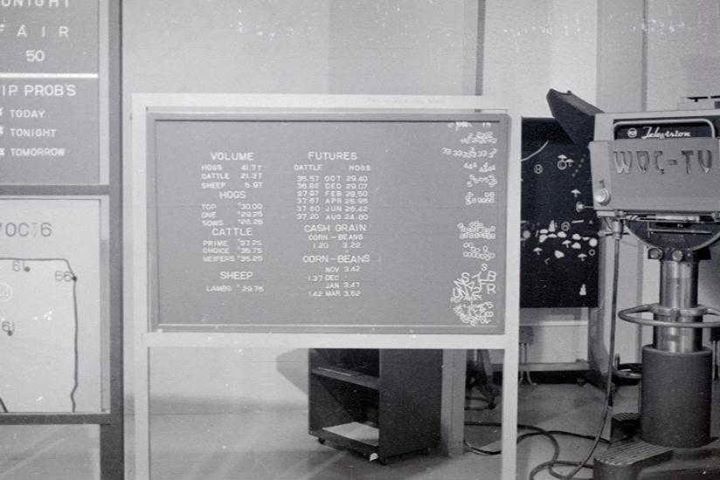
Before 1968, television graphics were either movable letters on a slot board like this, text on a slide, or white letters on a black flip card, or rolling credit drum that were superimposed over live shots. I thought Chyron was the first with this, but as it turns out, it was CBS Labs that lead the way. It’s an interesting story so enjoy and share. -Bobby Ellerbee
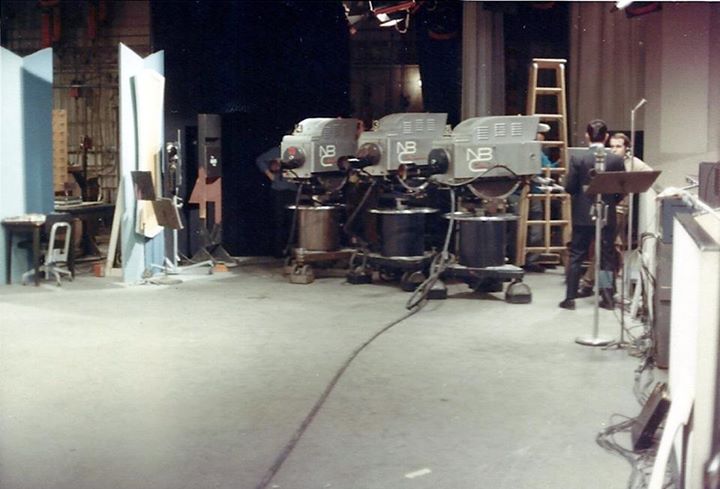
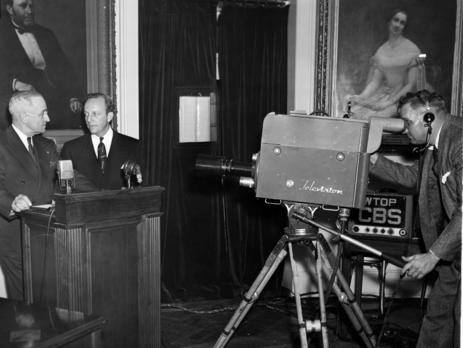
I always thought the Chyron VP1 and VP2 were interesting; I encountered both of them during my college days. The VP1 was driven by a language remarkably similar to HTML. The VP2? I could type my name on it, grab a cup of coffee, come back, and it *still* wouldn’t have finished rendering all the characters I’d typed.
… I worked a CHYRON II in Corpus Christi and a Vidifont in San Antonio ..crazy work ..was never proficient but for a basic job, I got by ..and what about that TK-60 ? ..looks like it had a ZOOMAR push / pull lens on it !
Not pictured: everyone rearranging the letters to spell inappropriate things between shows.
In 1984, an independent station I had worked at bought a used ‘Chiron’, that the previous station labeled as being from New Mexico. Manual photocopied to our employees did not have all of the commands to operate it.
The Price is Right used keycards long after the CG was common. Take a look at the credit roll, you can sees the key cards rotate into position. I believe this was the case up to the early ’90’s.
In 1972 when I started at WTVT in Tampa they had a Vidifont 1, serial #0003. A guy was training on it and it received very little use at first but within a year as I remember it had pretty much replaced those hundreds of super cards we had. Started training in it myself about a month after starting there and it was not that user friendly as I remember, but Ij kind f enjoyed learning it.
I remember helping install a VidiFont at WIS-TV in 1975. Later, everybody had Chiron (changed to Chyron in 1982). My first experience operating one came in 1980 at R/T with a Chiron III. At Unitel in 1986, I learned Chyron Mark IV, but rarely operated one myself then. Here’s a photo of what I believe is a Chiron II at NBC in Studio 6B in 1976:
https://www.flickr.com/photos/dennisdegan/515323416/
I just remember a big translucent drum with a long sheet of film attached for rolls…
This had to be coupled with the other invention, the fixed luma key, forerunner to the chroma-key.
We used a Chyron RGU2 for many years. Used the 8″ floppy for fonts,file storage etc…
In New York, NBC had a contract with an outside company–Vizmo that did rear screen projection for all the news programs. It was pioneered by Gil Zingaro and Marvin and Harvey Telmar. Now it’s all electronic.
This is giving me flashbacks to the Chyron VP-2 we used at IIS in the 80’s. You had one font with serifs and one without, in I think it was three sizes. and what, eight basic colors. If you spent a lot of time, you could program simple “animations” of the colors, to get a kind of marquee effect which looked VERY tacky, but was often in demand, just because it was some kind of movement. One time I used the VP-2’s color animation abilty to simulate a PONG game screen, complete with “moving” ball. Took a day to design:-). I also remember the day our expensive EPROM for the “Spanish” font arrived: it was the English font, with upside-down punctuation added for ! and ? When we started using a Pinnacle Alladin for graphics generation, I had a CD-Rom of over 200 fonts to import and work with, in infinite size variations, and the engineers were all like: “What would you EVER need more than the two fonts of the VP-2 for!?!?!” 🙂
I think the A.B. Dick character generator was called the Videograph. Its message drive can be heard cycling at 5:14 into this 1970 behind-the-scenes footage. I work at a station that after replacing its Videograph with a Chiron II, retained the Videograph to create slates. http://www.youtube.com/watch?v=lzKWF0U1xZ8&sns=em
I bought a Vidifont in 1982. Cheaper than a Chyron. Nice looking letters. Proportional spacing.
When I visited BBC Centre in 1984 they were still doing the most mundane graphic assignments on slides and camera cards, such as program credits, copyrights, simple lower thirds. I asked why, and their response was that electronic graphics were so “uninspired”. I suspect that it also kept a lot of graphic artists busy all day.
As late as 1983, my broadcasting classes in college taught us to make the black super cards with white stick-on letters – because there was no budget for a fancy character generator…
I like the portable camera on the right …(!)
“A Brief Homage to the Vidifont” — http://jcbd.com/vidifont/
My first exposure to digital trouble-shooting. Used a tape loop for page storage.
The credits for the first year of SNL (1975) were done with a long roll of paper, white text on black. Learned Vidifont in the early years at Broadway Video, ca. 1983. Then the Chyron 4100- 256 colors and you could kern text. Hot stuff!
My, how TV Graphics have come since the days of the Vidifont. 🙂 What was on circuit boards back in the day, now can be in the form of an all-digital TrueType or OpenType text font file.
I have a few 8″ Chyron disks up in the attic. They held what, 400 kilobytes?
I remember the Chyron 4100 as being a blood letting device. If you ever had to reseat the cards, you know what I mean, 😉