Computers And Automation vs Manpower And Innovation
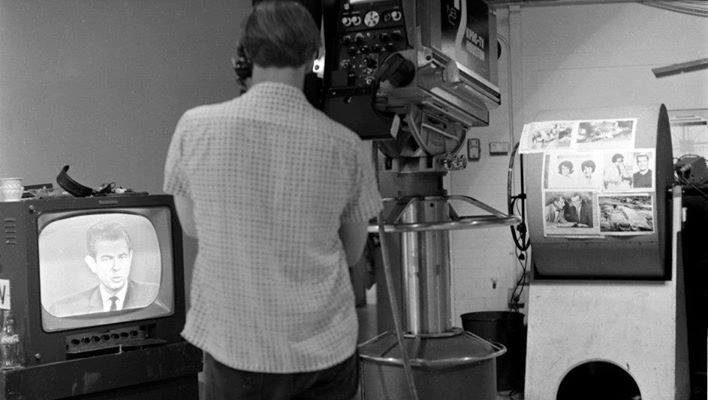
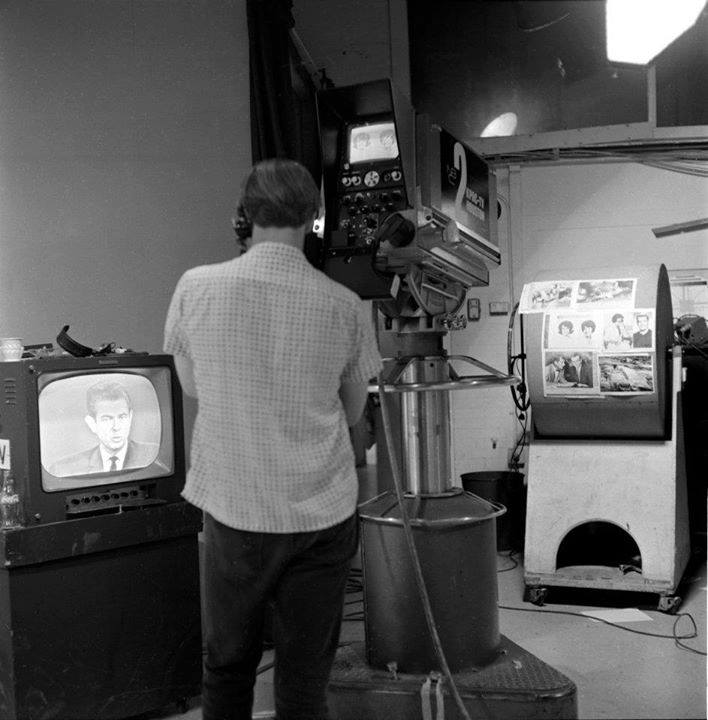
This shot from Houston’s KPRC is a great example of how news graphics were done in the 50s and 60s. Some stations had a nice drum like this, but others had easels, or old music stands. The images were faxed in daily from either AP or UPI. The camera is a GE PC 12, but there is more here than meets the eye.
For the younger generation of broadcasters, this must look like a scene from another world. And, it was another world. Radio and TV stations were owned by individuals that lived in the cities they served, and owners were making money, but profits were not always the holy grail…talented people and skilled staffs were. Those people and their innovations in ideas differentiated stations in a way that has gone the way of this graphics drum, in our cookie cutter media world. -Bobby Ellerbee
I remember keying graphics using a sandwich board and little white letters.
At WEDU in Tampa in 1966 we had a graphics drum but used easels more than the drum. At WTVT in 1972 we had a brand new Vidifont 1, but used it very sparingly in favor of super cards and a spaghetti board. A couple of us were training on Vidifont but it was still quite a while before we used it all the time.
When I first started in TV, we used 35 mm slides for many of the everyday “supers” such as talent names. There was a vidicon camera on the film chain that was so bad it could not be used for anything besides supers. The keyer on the video switcher added a nice drop shadow and it did not look too bad.
I still remember my first station had a CG with a dot matrix output, and could hold 4 pages of lower third supers.
We used telops for lower third supers.
Bobby…. Sad but true!
Reminded me of cable tv weather channels of the 70s. “The weather eye”
Yes, yes, yes.
Interesting enough, these particular B&W camera were bought new and were in service for only a year before KPRC replaced them with the GE color cameras. My photo circa 1966.
There were once switchers without keying capability. Titles were inserted by splitting the fader bars and sending more than a volt of video to the proc amp ahead of the transmitter. And if it was set to clip a little too high, you’d get that annoying intercarrier buzz, as the FM audio rode on the video in typical receivers.
Greed has taken over. Greed kills everything.
I remember turning a drum that was lit from the inside, shot with the camera, and had the sports scores on negative film attached to the drum. The weather maps were painted on pieces of plywood in a wooden box with slider tracks. The numbers, arrows, etc. stuck on them. As the weather was delivered, the forward most board was pulled out of the camera view from the side by the floor director using an attached rope, revealing the next map (i.e. United States, or local) etc.
In the early days of color at WFLD, Chicago, Dwight Bischel who directed the news shows, came up with the idea of coloring the wirephotos. Since they were on thin fax paper, he had interns coloring the back of the faxes with markers that bled through and added just enough color. We didn’t have a network affiliation so that’s how we covered national and world news.
One of my University of Houston class-mates was a VTR Operator at KPRC-TV.
I kind of miss those days when supers and graphics were time-consuming enough and difficult enough that folks were forced to pay attention to what they were doing. Like spelling names and words correctly.
Every time you turn on the TV, you just see an epidemic of errors, and it’s creeping into network broadcasts now.
Technology was supposed to make things better. Instead, it’s allowed managers to fire people and load the survivors down with more jobs than they can do well.
and electricity bills were out of this world!
What’s My Line (syndicated) used cards….and a guy standing by, flipping. Credits were on a roll. White letters on black background.
That’s how we did it in early 60s.
We had the music stands….
I still have one pix of a friend showing off his computer keyboard at KING TV in Seattle.