A Classic Candid And What It Tells Us…
A Classic Candid And What It Tells Us…
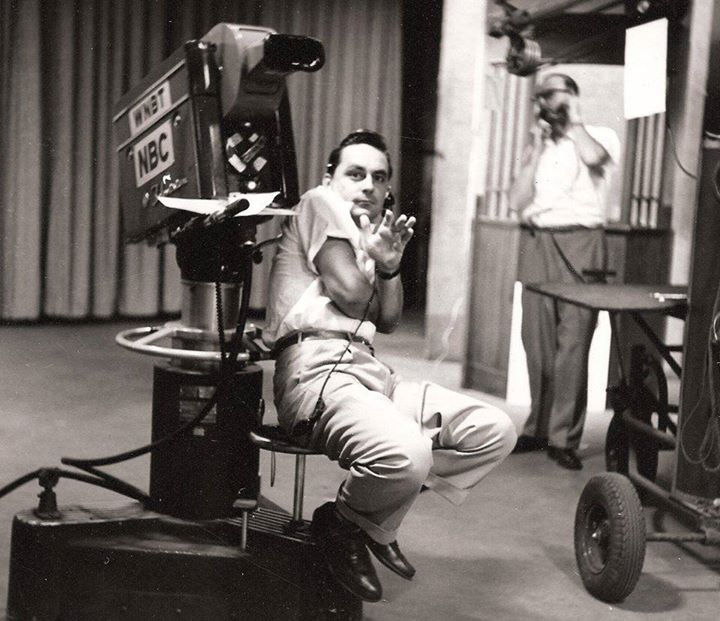
This is NBC cameraman George Kiyak goofing with the photographer in a photo shared by his son, Mark, but let’s look closer…there is something to learn here.
Notice the turret handle is at a 45 degree angle and not at it’s usual 90 degree taking position. What George has done is a “quick cap”… he has partially racked the turret between lenses to save the expensive Image Orthicon tube in this RCA TK30.
The pedestal is a Houston Fearless TD 1. George is sitting on the up/down crank wheel and these were geared to really move when you cranked them. The pedal under the crank wheel is called a trolley pedal. When you step on the TD 1 trolley pedal, it pushes down a castor wheel which allows you to move the base of the pedestal to another angle. Today, that is accomplished with Steer 1.
The castor wheel was used before there was a “Steer 1/Steer 3” option, which first appeared on the next generations of pedestals, the TD 3 counterbalanced pedestals.
The Steer 1 option allows you to steer like a tricycle with one wheel steering and the other two following, while Steer 3 is the, all wheels in the same direction, “crab” steering.
On the left side of the ped base is a cable grip which was usually a matter of preference…some liked them, some didn’t. On the very first TV pedestals which were built in the mid 30s, the cable came out of the bottom of the Iconoscope cameras and went down through the support column, exiting at the base of the column on a spring loaded arm on the right side of the camera. Believe it or not, those peds were electric and a small motor under the skirt moved the camera up and down. They too had trolley pedals.
Including George, everything here were the real workhouses of early television. Enjoy and share! -Bobby Ellerbee
Always half-racked. It was a reflex. The wheels to the right belonged to a Mole-Richardson Perambulator audio boom and could be adjusted to be more narrow if needed. That platform is what the operator would stand on.
We called the turret position “half racking” Used it to keep the I/O tubes from “burning.”
I find your posts on vintage cameras and camera mounts fascinating. Thanks, Bobby, for another great one!
Used to “quick-cap” all the time at WEDU in Tampa.
What a great description as well as background information, Bobby. Thank you for this.
As you mentioned, the trolley pedal was used to turn the whole ped to a different angle so that the operator could keep the crank wheel towards him during production. The problem with the trolley pedal was that it could not be used DURING production. When operating the pedal, the trolley wheel would lift the ped at a slight angle on one corner making the ped off-level. Therefore, the trolley wheel was only used to turn the ped when not shooting. When Steer 1 was invented, it allowed the operator to turn the ped while shooting with the camera. Even though that still would have been hard to do, the camera would not have been off-level while steering.
So what happened to ‘TD 2’? 😉
… very cool !