A Primer On The History Of Chroma Key In Television
A Primer On The History Of Chroma Key In Television…
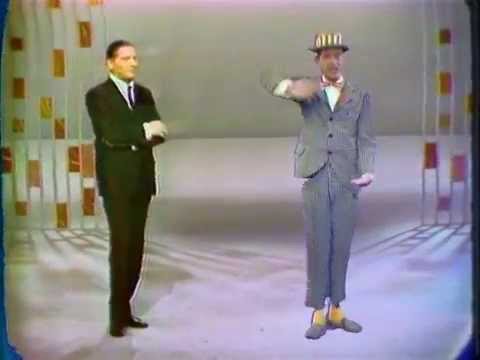
Was this Milton Berle chroma key sketch the first? No, but it is one of the most sophisticated early uses of the technology as it employs both chroma key and video tape editing. This was quite a feat in 1959!
Motion picture production had been using compositing for years prior to the invention of television, but it was an involved process requiring optical printers and intermediate film mattes, hardly suitable for the immediacy of live television.
In July of 1957, chroma key had its first on-air test on one of NBC Burbank’s more ambitious projects, ‘Matinee Theater’ that ran from 1955 to 1958. Every weekday afternoon, a one-hour live dramatic production was presented. The source material varied, but often it was an adaptation of some famous literary work.
A television version of the H.G. Wells classic “The Invisible Man,” lent itself perfectly for the first live use of chroma key. When the title character’s hands and head were wrapped in blue and he stood in front of a blue screen, the chroma key amplifier would replace the blue parts of the video with an image from another camera. All that would be seen in the composite shot was the man’s clothing in front of scenery being shot by the background camera, thus making him appear to be invisible.
Chroma key was developed by Frank Gaskins, NBC Burbank’s technical operations supervisor and Milt Altman, graphics arts supervisor. Together, they pooled their talent to develop what has become standard equipment on live video switchers throughout the world and now can be launched on any home computer. Today, blue has been largely replaced by the use of green, but is the same process. The key color change became necessary when video started to be compressed and primary colors began to be sampled at the ratio of 4:2:2, with luminence and green being the only fully sampled channel in most cases. -Bobby Ellerbee
[…] or video, which can help you make stunning special effects and bring imaginary worlds to life. Chroma key has been around for a long time, and as technology keeps getting better, people can now use their phones to make professional […]
I remember trying to do color matte off tape by taking the matte output from the color matte amp and recording it on a second machine.
During Sport shows, NBC always used a blue drape and then switched to green in the announce booth at the stadiums. The reason being, Curt Gowdy would always arrive wearing a blue shirt, therefore the “runners” had to go to the store and buy a shirt other than blue. Curt had a plan !!!! NBC must have gotten tired of buying new shirts for Gowdy every week therefore switching to green C. Key.
I suspect the “straight” Berle was the pretape. It would have been too hard to key videotape in those days.
We started using green long before compression and digital processors. Our reason for changing was that many news anchors had blue in their wardrobe. Hardly anyone ever wore green. In Las Vegas there was an experiment for a period of using yellow, but that was not good either, so green became the preferred color.
That was an awesome piece of early chroma key! I didn’t think they could pull it off in 1959. If they had been able to keep Uncle Milty’s shadows, it would have been nearly seamless.