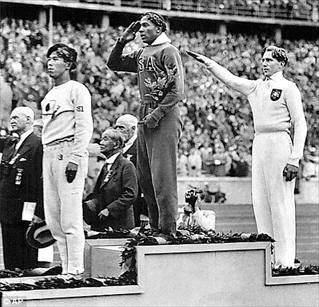
August 9, 1936…Jesse Owens Won His 4th Gold Medal In Berlin
August 9, 1936…Jesse Owens Won His 4th Gold Medal In Berlin
The first live television coverage of a sports event in world history occurred during the 1936 Summer Olympics in Berlin, Germany. These games were televised by two German firms, Telefunken and Fernseh.
Telefunken’s two large stationary cameras were based on RCA technology and the single, smaller Fernseh “roving” camera was based on Philo Farnsworth’s system.
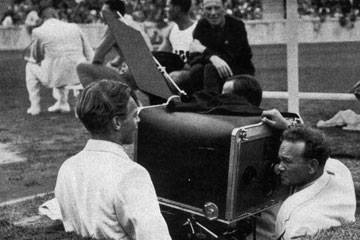
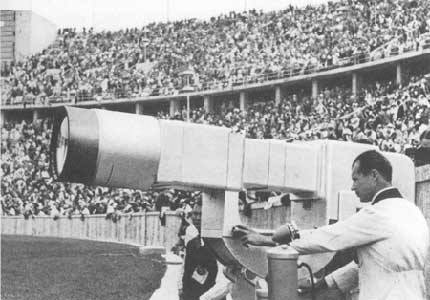
Above, the dark camera is the Fernseh camera and was a bit smaller than the big white Telefunken cameras. Both systems broadcast at 180 lines and 25 frames per second. Four different areas were telecast using three cameras. In total, 72 hours of live transmission went over the airwaves to special viewing booths, called “Public Television Offices” in Berlin and Potsdam.
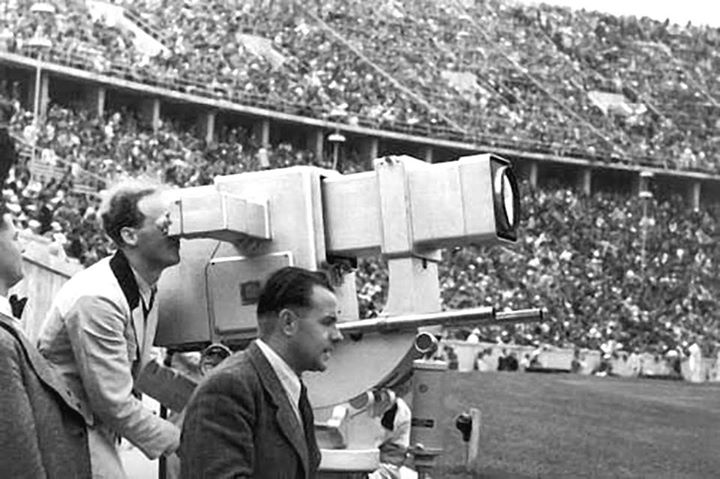
The cameraman looking into the viewfinder on the Telefunken is Walter Bruch who later went on to develop the Phase Alternation Line System, or PAL that, was initially adopted by more than thirty countries and eventually, more than one hundred. When interviewed by German talk show host Hans Rosenthal on why he had named it the “PAL system”, Bruch replied that certainly no German would want to have a “Bruch-System” because Bruch in German is synonymous with “broken”.
By the way, the Telefunkens appear to have zoom lenses, but they’re not. There were several fixed focal length lens options that could be changed out (a 2 man job), and we can see an example of that in the telephoto lens shot. They have placed the focus mechanism on the outside of the camera instead of inside, and are already using cradle heads instead of friction heads. Enjoy and share! -Bobby Ellerbee
It’s worth noting that PAL was also a practical name since it was eminently descriptive of the key color transmission feature: the phase that alternated with each line (hence Phase Alternating Line) helped make PAL transmissions more tolerant of multipath interference (“ghosting”) in the challenging geography of western Europe, which the current generation of TV viewers seems to be blissfully ignorant. Of course, it made both editing and later digital conversion of analog originals much more difficult because of that every same feature (and the fact that the phase didn’t return to 0º point for eight fields instead of NTSC’s four, making color editing a real challenge), but that would be in the future….
What is your cite for the 180 line number? I’ve seen 360 as the resolution, which was similar to the British system that went on the air the same year in London.
“Fernseh” being German for “television” of course….
Camera look interesting
In a few years germany will be speaking farsi
PBS aired a special on the Berlin olympics and had film of the coverage. Quite interesting.