CBS Field Sequential Cameras…Modified RCA TK10 Monochromes
CBS Field Sequential Cameras…Modified RCA TK10 Monochromes
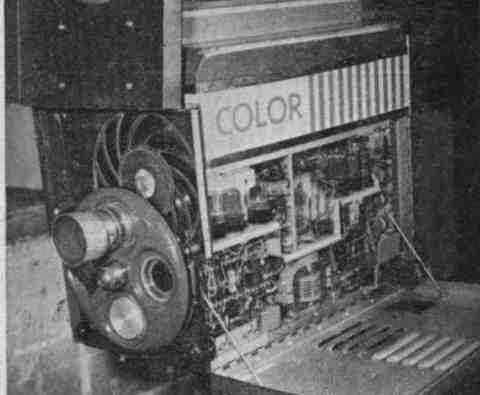
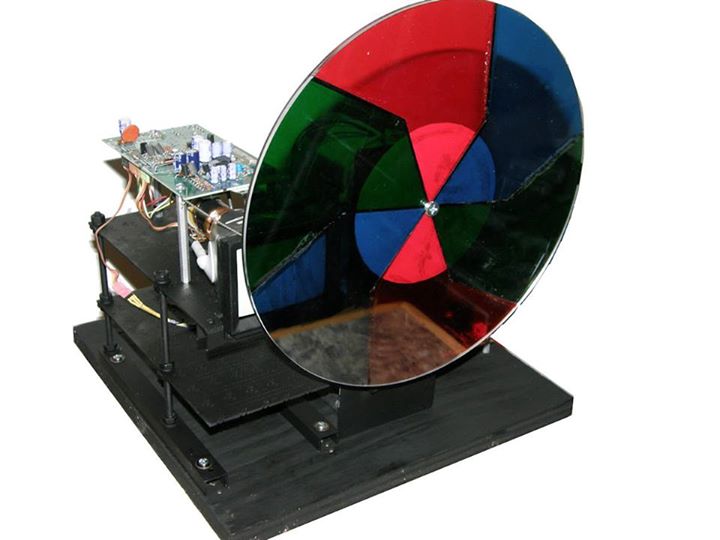
In a nutshell, the Field Sequential System colorcasts were actually black and white pictures transmitted with a sync code which would synchronize the home receiver wheel with the broadcast wheel. In the color photo, we see a reproduction of the wheel that went in front to the home receiver screen and on the close up of the camera, we see behind the lens the color disc that sort of generated the color picture to be transmitted.
Here is a very simplified description of how this worked. The image is scanned at 144 fields per second. Each field is one complete image of either red, blue and green. As each field scans down the screen, the color wheel places the correct filter in front of the tube. After six fields have scanned, and the wheel has made one complete rotation, a complete color frame has been formed. The color frame rate is 24 frames per second, same as film. The wheel is spinning in perfect time to the video color frame period and is turning 24 times per second, which is 1,440 RPM.
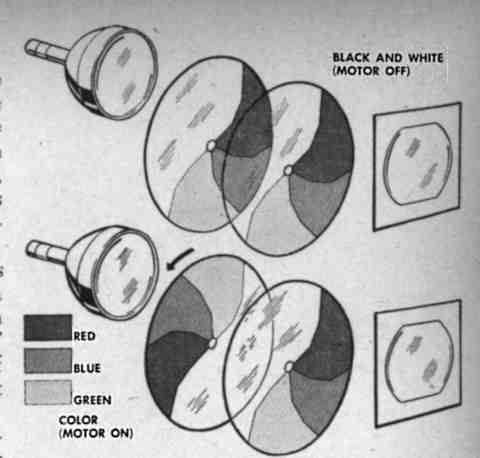
On the original 1949 wheel design from Dr. Goldmark, who invented the system, there were two color wheels with half of it clear so that when black and white programs aired, the clear portion would lock in place on the camera and the receiver. This was too difficult to do, so the system went to a single color wheel that was used in the historic telecast sixty three years ago today. Enjoy and share!
Wow!
this technology did not go away, it is used today on all single chip DLP video projectors.
Glad we didn’t adopt this! Could you imagine the size and velocity of a wheel for a 50-inch set today?
By the way, I recently saw this https://www.youtube.com/watch?v=Tauqy199yv0 which demonstrates a working CBS style monitor.
I is worthwhile to not that the FRENCH analog system SECAM was actually an electronic version of the field sequential system. SECAM meaning Sequential with memory. It only caught on in Franc and Russia, and is sometimes called “System Essentially Contrary to the American Method” (of course european folks say NTSC is Never The Same Colour.
The early color camera used for Apollo were field-sequential, I seem to recall. Color imaging tubes were as yet too fragile for space conditions.
Though the color wheel might not have ever been eliminated entirely, it is possible that the CBS color system could have evolved into an all-electronic version of field-sequential color. The SYSTEM itself wasn’t the problem. The problem was that it required a completely different field/frame rate from existing B&W TV transmission and was therefore incompatible. In order to succeed, the entire industry would have had to change over to this new transmission system, thereby making obsolete all currently operating B&W TVs. That’s the real issue that made the CBS system unsuccessful. Given enough time and cooperation, the CBS color system could have succeeded. As an example of the possibility, our present-day HD TV required the same kind of change to a completely new system of transmission. It took over 10 years and an overlap of technologies to allow the marketplace to accept it, but it has happened. Now, NTSC is dead and we have digital HD TV everywhere.
Thanks for the posts Bobby. I knew of it but I never knew the specifics.
My family had an old monochrome receiver for a time in the seventies, that was from the early fifties. I think it might have been a sears model. I loved looking in the back at the tubes. There was one socket marked “color” without a tube in it. I think this was in anticipation of a color wheel accessory, perhaps that socket was intended to change the synchronization?
The color wheel was revived with one-chip DLP sets. I used to have one. The part that wore out: The color wheel.
Interesting to see that the reciever reproduction uses solid state electronics instead of the tube technology that would have Ben available to the designers.
Crosley made a housing, that would a 10 inch CRT, to convert a b&w TV set to color. Picture taken when I was at the Early TV Museum.
What a TV receiver for field sequential would had looked like. From the Early TV Museum near Columbus, Ohio.
Can you imagine how big of a color wheel would have been needed for the large sets that came later? Wow.
🙂 https://www.youtube.com/watch?v=O5tf6SQjFlQ