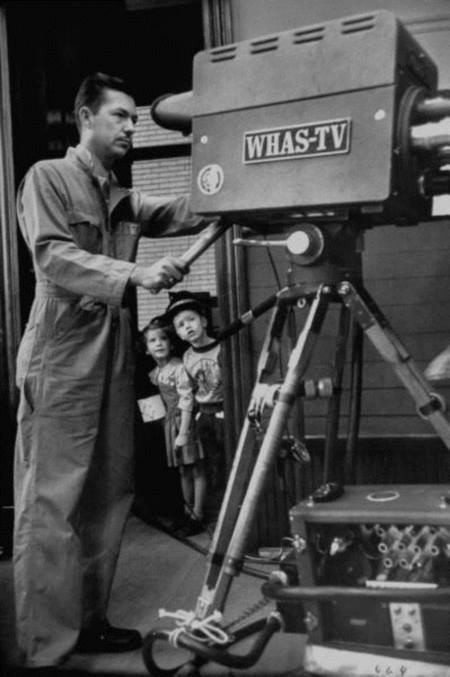
Technically Speaking…The Dumont 124 IO Camera
Technically Speaking…The Dumont 124 IO Camera
Finally! Thanks to 51 year TV veteran Bill Freiberg of KTRK in Houston TX, who started with Dumont equipment, we finally know some of secrets that had been lost for so long on these cameras. Below is his letter to me and a photo of a Dumont 124B in use. Enjoy!
“First let me tell you how much I am enjoying your website. I am in my 51st year in this business and cut my teeth on DuMont studio gear starting in 1962. The station was originally a UHF DuMont affiliate, but went dark, then when the freeze was over, the CH 13 people bought the facility. We had DuMont cameras, switchers, a color Multiscanner, sync generators, consoles, the whole megilla.
The DuMont TA-124 was a 3” Image Orthicon camera, it was later branded and sold by G.E, but was still made in Passaic, it was the same camera as the 124-E. The camera had the I/O at the lower
right position (looking from the rear), as opposed to the RCA, which had the I/O in the top center.
The connectors were unique to DuMont, there were A, B, C, D, and E cables, differing mostly in the number of coaxes within. The camera was fed by a small box called the “aux” unit, which contained the equipment for cable equalization, blanking and timing, and voltage regulation to compensate for differing cable lengths. Yes, the 124s could and did work on booms, perambulators, pedestals, tripods, anywhere an RCA could. There was a finite length limit to the aux to camera, but it was usually installed near the camera for setup convenience.
At KTRK, we had them at the camera control position on the
2nd floor. We built a lot of our own cables there. Even built “orbiters” to slowly move the image on the face of the I/O to minimize image burn in. RCA used an optical wedge which turned, we used coils around the front part of the tube. Wound them on a coffee can, as I remember.
The focus handle screwed to the lower right of the camera body, and moved the I/O back and forth, along with the deflection coils. We always had a set of the little flex cables, about 2″ long. They made up for the angle at which the handle presented to the camera body. The last 3″ of the handle turned in order to focus. The TK 40/41 used a similar system.
Iris setting was manual, but DuMont at one time had a kit which had gears on each lens. A handle at the rear was pushed in and rotated to set the iris for the lens in use. We just left ours at 5.6 in the studio and 8 or 10 outdoors. We never had iris control at the CCU.
We had a show we did once a year for which we had to pull all
the stuff out of the step can/milk truck and tote up four flights of stairs. We called it the annual KTRK hernia festival.”
Thanks to Bill for the note. Anyone that would like to share the same kind of information on the various cameras and video tape machines they have worked with, please send it to me!
I think this man’s last name is McGregor. His family lived a few doors from us in Louisville and he worked at WHAS. We watched our first tv at his house on a set he built. The picture was green and white. That was probably late 40s.This might have been T Bar V Ranch children’s show with Tom Brooks, Foster’s brother.
Does anybody know how to contact Bill Frieberg? I worked with him several times back in the 1990’s. When I started my Telecruiser project (www.telecruiser.com) he sent me some pictures for the web site, but I’ve lost track of him. I’d like to reconnect.
Image Orthicons were much more fragile than more modern tubes. They also needed lots of light. Burning in was a real issue. That’s why the image orbiters were invented. They slowly moved the image over the surface of the tube to reduce burn ins. An IO camera locked up for a few minutes on a high contrast graphic would retain the image for quite some time. The only cure was to burn of the image by soft focusing on a white card with lots of even light. This had the negative effect of reducing the tube’s sensitivity, so camera operators had to be very careful with these tubes.
Wow! Having never worked with turret cameras, I never imagined that having remote iris control at the CCU would be a challenge! How did other manufacturers cope with this? I think IO tubes were less fragile and cheaper than Plumbs or Saticons, so iris control by the video op was less critical, right?
I talked to Bruce Dumont in Chicago Thursday.
I’ve probably met Bill.. I was in Explorer Post 13 at KTRK from 1966-69. I can second his comment about the hernia fest. KPRC had a couple of DuMonts they used to televise our churches service. One was in a control room on the fourth floor. They would have to pull them out to cover space shots and I helped carry them down. Fortunately the viewfinder separated.