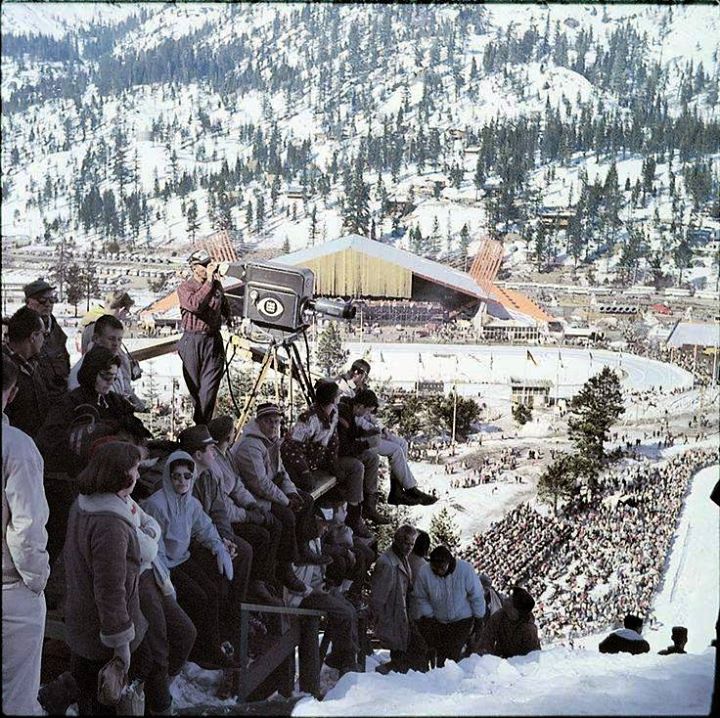
1960, CBS At Squaw Valley Olympics
The Start Of Something BIG! Instant Replay…
In 1960, CBS paid $50,000 for the rights to cover the Winter Olympics in Squaw Valley, but paid $550,000 for the Summer Olympics rights that year which came, via couriered video tape, from Rome. Winter Olympic rights would never again be such a bargain, and sports nor television would ever be the same as this is the first time a video tape playback was used to determine the winner of an event.
During the Games, CBS broadcast 15 and a quarter hours of television focusing on ice hockey, speed skating, figure skating, alpine skiing and ski jumping. During the Games; in the men’s slalom event, officials who were unsure if a skier had missed a gate asked CBS if they could review tape of the event. This request gave CBS the idea for what is now known as instant replay.
While the first near-instant replay system was developed and used in Canada, the first instant replay was developed and deployed in the United States by ABC. During a 1955 ‘Hockey Night in Canada’ broadcast on CBC Television, producer George Retzlaff used a “wet-film”, or ‘hot kine” (kinescope) replay, which aired several minutes later. Slow motion replay was brought across the border to America a few years later by ABC.
CBS Sports Director Tony Verna invented a system to enable a videotape machine to instantly replay on December 7, 1963, for the network’s coverage of the Army–Navy Game. The instant replay machine was a modified quad video tape recorder which weighed 1300 pounds. After a few technical glitches, the only replay broadcast was Rollie Stichweh’s touchdown. It was replayed at the original speed, with commentator Lindsey Nelson advising viewers “Ladies and gentlemen, Army did not score again!” The problem with older technology was the difficulty of finding the desired starting point; Verna’s system used audio tones activated as an interesting event unfolded, which technicians could hear during the rewinding process.
Replay in slow motion from analog disk storage was tried out by CBS in 1965, and commercialized in 1967 by the Ampex HS-100, which had a 30-second capacity and freeze frame capability. Unfortunately one of the few remaining HS-100s was trashed last year as NBC continued the clean out at Burbank. Thank to Kevin Vahey for the great photo of and RCA TK11/31 in action on the ski jump.
HS-100: Remember when the heads would stick to the disk and leave a :- pattern?
HS-100: We had a saying at Editel: “When they worked perfectly, they just barely worked.” A design oversight meant the heads would “freeze” if sync was interupted, ruining the disks and heads, and airline crews had no respect for the “Fragile” stickers, as the three parts in shipping cases were both heavy and delicate. Spent many an overtime hour replacing disks and heads; bought my house.
As chairman of the Pageantry Committee, Walt Disney produced both the opening and closing ceremonies.
Late ’60’s-early ’70’s..two Gaylord independent stations..KTVT Ch11 Ft Worth & KHTV Ch39 Houston had the Ampex HS-100 & HS-200 Slo-Mos. Ft Worth used it for production & Houston used it for Astro baseball telecasts & production…Great tool…but the chief engineer in Houston hated it…Houston had theirs for 2-5 years…the one inch VTRs with Slo-mo & freeze frame too the Ampex out ..I still have a degaussing rod, used to clean up the two disc…a production guy, Mike McCray was a whiz at instant replay, and still save a video for the bump out to commercials… Only had 30 secs of space…memories..
Those HS-100’s were beasts to maintain. Head alignment was super-critical and was really tough to do. Try sticking a long thin screwdriver inside a plexiglass chamber holding two spinning 15-inch diameter discs without touching the discs. It was a challenge. Reeves/Teletape had two machines they had specially modified with their own solid aluminum mounting blocks; much more sturdy than the original ones from Ampex. R/T had a metalwork shop manned by two German craftsmen who made the aluminum blocks. Those guys could make nearly anything out of metal.
You have to wonder if CBS ever kept the videotapes of the Rome Olympics, or sadly, reused them?
Hosted by Art Linkletter.