The Wide World Of Broadcast Formats
The Wide World Of Broadcast Formats
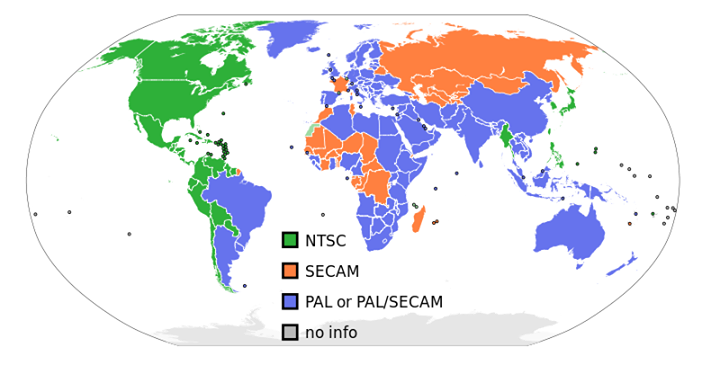
There are three main television standards used throughout the world.
NTSC – National Television Standards Committee
Developed in the US and first used in 1954, NTSC is the oldest existing broadcast standard. It consists of 525 horizontal lines of display and 60 vertical lines. Only one type exists, known as NTSC M. It is sometimes irreverently referred to as “Never Twice the Same Color.”
SECAM – Système Électronique pour Couleur avec Mèmoire.
Developed in France and first used in 1967. It uses a 625-line vertical, 50-line horizontal display. Different types use different video bandwidth and audio carrier specifications. Types B and D are usually used for VHF. Types G, H, and K are used for UHF. Types I, N, M, K1 and L are used for both VHF and UHF. These different types are generally not compatible with one another. SECAM is sometimes irreverently referred to as “Something Essentially Contrary to the American Method” or “SEcond Color Always Magenta.”
PAL – Phase Alternating Line
Developed in Germany and first used in 1967. A variant of NTSC, PAL uses a 625/50-line display. Different types use different video bandwidth and audio carrier specifications. Common types are B, G, and H. Less common types include D, I, K, N, and M. These different types are generally not compatible with one another. Proponents of PAL irreverently call it “Perfection At Last,” while critics of its enormous circuit complexity call it “Pay A Lot” or “Picture Always Lousy.”
Here in Brazil still uses the analogue PAL-M (525/60 version of the European PAL system) since 1972. It was an arbitrary decision of the Brazilian military dictatorship (1964-1985), against the broadcasters, who preferred NTSC, including making experimental transmissions since 1963. Today happens to transition to digital ISDB-T.
Years ago in West Berlin, watching on a PAL set, I believe the East was on SECAM, you could watch East German television but it was grainy and black and white. The audio came through clearly.
I am still wondering of their is a non-engineer explanation of the digital format(S) used. I understand that the receivers have to accept several formats as the decision was made that the “market” would decide what formats the broadcasters used. I don’t know if there is any reall difference in international digital standrds, although the frame rate seems to be variable. including a 59.9 rate that is held over form NTSC.
The incompatibility in DVD recording is a “Feature not a bug” it was added to allow the movie industry to release movies in different markets at different times. if not for the “Region Code” all DVD disks should be compatible. There are “region free Players made in some places but they are considered as “Piracy” because – Yes – you could watch a movie that has not been released to DVD in your region.
Now any differences are automatically handled by a single rack space converter box.
With the transition from analog to digital, I could never understand why the “powers that be” didn’t use this great opportunity to come together and agree upon a single global standard.
NTSC – Never Twice (the) Same Colour, SECAM – System Electroniique Contre (Les) Amerciains, sorry my late friend Joe Roizen!
Ricordi …!
More blue area therefore it is the best. 😛