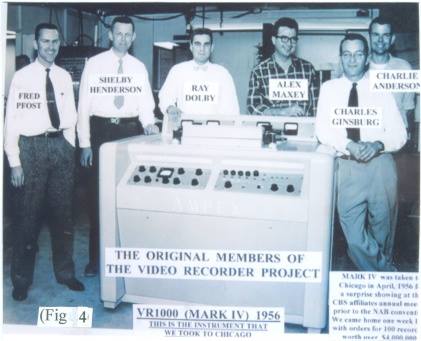
 On April 14,1956, this prototype Ampex VTR called “Mark IV” started a whole new era in television. In the photo, you see the Ampex Videotape Team…the men who created the VR-1000 and revolutionized broadcasting. Pictured with this six man team is the unit Ampex took to Chicago for the legendary demonstration at the 1956 NAB Convention, to the amazement of all who attended.
In the team photo, Fred Pfost is on the far left. Here is Fred’s description of the events of the week of the demonstration in which Ampex took almost 100 orders for the $50,000 VR-1000.
“On the Saturday, April 14, two days before the convention started, we demonstrated the recorder for about 300 CBS affiliates meeting at the Conrad Hilton Hotel. I recorded (from behind a curtain) the opening speech of Bill Lodge, V.P. of CBS, who described all the activities that CBS had been involved in during the past year, and his announcement of a big surprise, that was about to happen. After I rewound the tape and pushed the play button for this group of executives, they saw the instantaneous replay of the speech.”
“There were about ten seconds of total silence, until they suddenly realized just what they were seeing on the twenty video monitors located around the room. Pandemonium broke out with wild clapping and cheering for five full minutes. This was the first time in history that a large group (outside of Ampex) had ever seen a high quality, instantaneous replay of any event. The experience still brings tears to my eyes when I recall this event.”
“During the week of the convention, the Ampex display area was packed, all day, every day. Orders came so fast and furious, that the Ampex sales staff was writing orders on cocktail napkins.”
It took Ampex a year to fill just the orders taken at the convention. If memory serves me right, CBS got the first 5, NBC got the second 5 and ABC, the third 5, with more on order for all 3 networks. I think CBS put 3 at TVC, and had 2 in NYC. NBC put 3 at Burbank, 1 in NYC and 1 went to RCA Labs in Princeton, with RCA and Ampex starting to share RCA’s color tape ability. I think ABC put 3 at Prospect and 2 in NYC. -Bobby Ellerbee
The VR-1000 was what we had in 1962 when I first started television in Amarillo, Texas at KFDA-TV 10.
And then a bit more than 30 years later we all had to make the momentous decision – VHS or BETAMAX ???
https://youtube.com/watch?v=11hRt_5-HRM
David Fell
Yeah, there was still one of these, converted to color, in service when I was at WBBM-TV.
CBS LA donated one that looked just like that to KVCR-TV at San Bernardino Valley College. I wonder if it was one of the originals? It came with 3 racks full of tubes!
KEPR TV had one of these when I worked master control there in the early 70’s. It had been upgraded for color playback.
There was one at WMUB-TV at Miami University in the mid 60s. About ten years later I got to use a color-converted machine at the J.D.Ivey Company in Orlando. We had a contract to copy Sesame Street Spanish-language programs for various island stations The shows came in on quads and were dubbed over to 3/4″ or the old IVC 1″ formats.
There was one at Channel 26, too, in the prop room. I was told it was the one bought off the NAB floor by ABC. It moved to Fred Niles to be used to spool off distribution dubs.
Frank McCoy That’s right, I remember that now. I was told that when it was delivered to WCIU that a man followed it in. Said, “you need me to run that thing.” It’s my understanding he was hired.
And then there was Gaucher.
Frank McCoy That would be “legendary” Gaucher.
We had two of them at Channel 8 in Houston around 1966. Only one could handle color.
After we added our VR 2000 in Amarillo, we could playback color from our 2000 and record on the 1000, to do layering, Sometimes going down as much as 3-4 generations swapping the tapes from recording on 1000 to playing back on 2000. Of course after that many generations it was not the best quality.
Thanks to them…and others…I had a wonderful career in video/TV production. We stand on the shoulders of others.
Georgia Educational Television Network had a 1000 in our Blue Bird remote bus in the 60’s.
Inside that big box, were rows and rows of vacuum tubes. The heat thrown off was intense. I operated and repaired the very early RCA five rack color quads with a Tube tester and a pair of work gloves at my first gig at WENY-TV, in Elmira NY. Larry Taylor, my first boss, was awesome. Anchorman, Vince Murphy, drove the bus route every weekend from Elmira to Corning and back. He was a small town celeb. Did everything at this job, except clean the bathrooms. Amazing how far the technology has come. My phone now does more than all that studio and control room full of equipment, and does it way better. But those guys at Ampex and RCA made everything possible that followed.
Operated one of these beauties at WTHS Ch2 Miami in 1963-64. Worked under Reggie Simmons in those days.
The first one to go to a non-O and O went to WFIL-TV Philadelphia, and 10 years later was being used to record the exercises of our Temple Univ production classes taught in those studios by Lee Klein. Ironically that same machine followed me to Univ of Missouri-Columbia where it recorded the exercises in the production classes I taught in 72-74. I saw it again two years later when it was displayed at NAB for the 20th Anniversary.
Happy Birthday, VTR!!!
KGBT, CBS/ABC Harlingen, Tx was 1st to get a video tape recorder-an Ampex…KRGV, NBC/ABC (owned by LBJ (Ladybird) purchased an RCA tape recorded..(rack mounted), Put it in a custom made trailer that backed up next to the projection room for studio playback and took the trailer on the road to record all kinds of location comms.
Went so far as to tape night comms for PB at night, and daytime spots to a air the day parts. Usually recorded comms before noon, or after the 10pm news… Would kine some tape spots for air in a real conflict. Even aired sports and entertainment pgms from Mexico. Next came a COLOR FILM-CHAIN…. Fun times.
Another early adopter: George Storer. Back when WAGA was.
Learned transistor theory from the Ampex 1200 shop manual!
Recall these machines at KTLA in 1959.
I wonder if they taped The Spade Cooley Show(all girl band) which was on KTLA around that time..
Spade Cooley was a “Western Swing” band, while Ina Rae Hutton was the all girl band.
I worked at KTLA starting in 1960, always awed by these majestic machines. In 1966, I became Videotape
Librarian, when these huge machines were replaced by a newer model which handled color.
The VR-1000 and VR-1200’s were groundbreaking but did in fact work for real… and many of us had hands on as they were rugged beasts as well. The first I had hands on with was a much later VR-5000, then when I went to college I got real life time with the 1000 and 1200 still in day to day use.
And today, our electronic devices become obsolete in a year or so… The VR-1000 lasted until 1964, when the VR-2000 was introduced.
Ray Dolby? Whatever happened to him? 🙂
He was compressed.
Must have used tubes?Solid state was just emerging then…Of course Dolby fared well with his own inventions..
Bing Crosby was a major player in developing the first VCR.
Saw the restored #1 VR-1000 at the Ampex museum. Fascinating!
KLRN-TV owned the 1000th VR-1000 off the production line. It had a small metal plaque on the chassis commemorating the sale, and was still functional when I worked there in the late 70’s. The thing was a behemoth! Wonder where it ended up?
I started in TV in 1966 learning VR1000Cs.
USAF inTexas 1969 VR 1000 sitting next to an RCA TR-1. That was history.
Where’s ‘Tom Farmer’???
When I started to work in television at TV Globo Network in Rio de Janeiro, we had two of these VR1000A and one VR1100. Before 1972 all TV Globo production was done (edited) in VR-1000A’s
Videotape: One of the most remarkable inventions ever conceived for the industry. And at one point scientists and electronics experts could sit down with you and show you with paper and pencil why it could NEVER work!
One day in 1980 I was in the Redwood City Radio Shack and I happened to notice the name on the credit card of the gentleman checking out ahead of me. It said: Charles Anderson. I looked up, and there he was in the flesh. I told him that I was very familiar with his accomplishments, but of course he was very humble, and gave credit to the entire team. I told him about my career in television, and how his team had made it all possible. We had a great conversation, and it was a wonderful day that I’ll never forget. (Except that I had forgotten, but this photo reminded of it). Thanks for posting it!
When I was working in the industry years ago I heard that it was Ray Dolby who came up with the idea for the helical scanning head. I worked on some 1200B’s and the amazing AVR-1 with the MK-XX head. What a machine that was, probably the best VTR ever made.