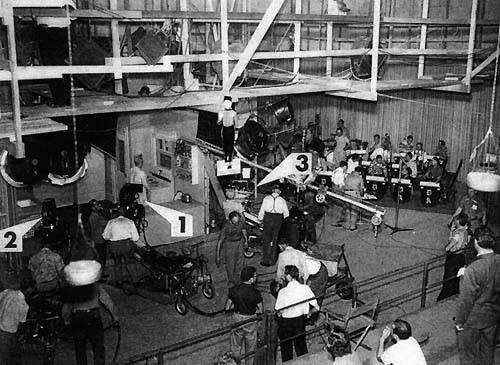
How ‘I Love Lucy’ Was Produced…The Details
Above is a view of tri-set layout on Stage 2 of General Service Studio where the weekly “I Love Lucy” film show is produced. All lighting is from overhead, with units mounted so they can be changed with a minimum of time and effort. The show is photographed with three Mitchell 35mm BNC cameras, all shooting simultaneously. Camera (1) in center makes all the long shots, while closeups are filmed by cameras (2) and (3) at either side. Besides floor markers and memorized instructions, technical staff also is monitored by script girl via intercom phone system as show progresses. Retakes are rare and time between setups averages but a minute and a half.
Although each weekly show goes before the cameras at 8 o’clock Friday evenings, and is photographed entirely the same evening, the preceding four days are employed by the company in rehearsals, pre-production planning and script revision. the camera crews have but two schedules in the five-day period — on Thursday and Friday.
The director, actors and writers gather on the stage for a reading of the script on Monday and Tuesday; late Tuesday afternoon the first of the rehearsals are held. By Wednesday afternoon, the company is ready to run through the show for Director of Photography Karl Freund. This usually takes place at 4:30. No cameras are on the set at this time, nor are any members of the camera crews present. During this rehearsal, Freund studies the players and their movements about the sets, takes notes of how and where they enter and exit, and plans his camera operations and lighting accordingly.
The following morning at eight o’clock Freund and his electrical crew begin the task of lighting the sets, and endeavor to have the job completed by noon. At this time, the camera crew members come on the set and are briefed on camera movements, etc. With the crews and cameras assembled on the stage, camera action is rehearsed. This enables Freund to make any necessary changes in the lighting or operation of the camera dollies. Cues for the dimmer operator are worked out at this time. Chalk marks are placed on the floor indicating the positions the cameras are to take for the various shots or the range of the dolly action for a given scene.
At 4:30PM Thursday, there is another rehearsal — this time with the camera crews, gaffers, sound men, etc., on hand. Then at 7:30 the same evening a dress rehearsal is held, Freund, camera operators, gaffers and grips are on hand — but the cameras are not brought onto the floor. At this time the general plan of the show is discussed by the director. Notes are made for future guidance by all present. An open discussion then follows at which time lines of dialogue are cut, action shortened or deleted, camera movements analyzed…in short, everything is done at this time that will tighten up the show and improve its pace. This is the period in pre-production planning when problems are aired and suggestions made and considered.
On Friday, when the show is scheduled to be shot, there is a 1 PM call for everyone in the company — players, technicians, the producer and the director and his staff. If any major changes in the action, dialogue or camera treatment were decided in the previous evening’s discussions, these are now worked into the show during another general rehearsal.
A final dress rehearsal takes place at 4:30 PM, with the cameras now on the floor. Freund gives his lighting a final check, makes any necessary last minute changes before the company breaks for dinner.
After dinner, company and cast return to the stage, and there follows a general “talk through” of the show. At this time, further suggestions are considered and decisions made on any remaining problems, so that by 8 o’clock the company is ready to film the show.
In the meantime, the audience seating on the stage has rapidly filled and Desi Arnaz or some other member of the company is briefing the audience on the show, explaining the filming procedure, and emphasizing the importance its natural, spontaneous reaction plays in the show’s success.
Then for approximately sixty minutes the show is filmed. As soon as action is completed for one set up, the cameras, crew and players move rapidly to the next set up, and the action is resumed. All scenes are shot in chronological order. Each episode is 22 minutes long.
And had a live studio audience!
Lucie Arnaz Luckinbill you are correct. I was not responding to the fact that it took sixty minutes to film. That is WAY different now. I was responding to how little the technique, the process, has changed. Still shot the way it was back then. That’s impressive. One hour dramas have changed how they are shot dramatically. Not so, the sit com style of shooting, which Desi created.
Very interesting
Yes, it worked then! But then “Friends” decided 5-6-7 cameras might be better and kept rewriting until the third audience seating left the stage at o-dark-thirty Fraturday. Jus’ sayin’ I might be a little jaded.
But to pay homage to the man, Desi Arnaz, for the three camera style sitcom production technique, bears repeating, often! I can safety attest to the fact that many of my dear friends and I have certainly profited from the fruits of his genius.
It worked then , and we still try to follow this system today. Except for all those hybrid versions.
Fantastic…thx for posting..
I have attended two tapings of situation comedies in Hollywood. They both took four to five hours to tape. Apparently, today’s actors aren’t as disciplined as they were back in the days of “I Love Lucy”. One of the shows was filmed. I got to talk to one of the cameramen during a break in filming. He was an older guy who had worked in Hollywood for years. He was operating a 16mm Panavision camera. I didn’t know such a thing existed. After each scene, someone would shout out “Check the gates!”
Did anyone notice the small “Johnny the page boy” in the center calling for Phillip Morris?
What was the edit schedule?
Thank you for this… The standard we follow today.
The good old days, good shows like that, of course, all of your shows are super!!! Have a good summer, my son Ryan is getting married in Sept. Busy times but happy times.
It’s not done much differently now. The schedule is pretty much the same.
22 minutes for each episode? That means the opening and closing credits, commercials and other elements took up six to seven minutes of each network episode? I’d think content would be more like 24 to 25 minutes. But hey, I wasn’t there. Fascinating article, though!
There are old photos in the studio at what’s now Las Palmas Center Studios. They show the crew dressed in suits and smoking on the floor. Great memories.
1000 ft of 35mm is 11 minutes worth without any clappers etc. I wonder what size loads they used and what the shooting ratio was – beside the 3:1 built in by having three cameras running at all times.
Thursday 4:30pm meeting is where it’s at. 🙂
Very interesting…
The birthplace of the sitcom. Very cool.
Amazing.
This article has a lot of insight into the process of making early television. Everybody was at the top of their game and it worked.