Surprise! CBS Had Marconi Mark IV’s In 1960…
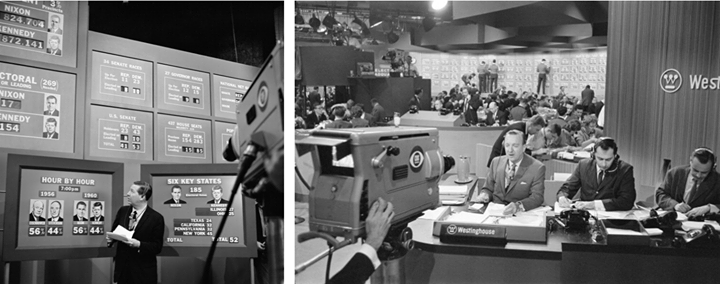
For those of us interested in the technical side of broadcast history, this comes as a surprise. Pictured here are two shots from the set of the November 1960 Presidential Election coverage, in which John F. Kennedy defeated Richard Nixon.
This was at the CBS Grand Central location, where, for this occasion Studio 41 and 42 were combined to handle the coverage. I, along with many others, had always thought the Mark IVs came into service around 1962, just before CBS moved to the Broadcast Center in 1964, but obviously not.
In addition to the two big studios at Grand Central, CBS had about a dozen other studios in operation in NYC in 1960. They must have had at least fifty RCA TK10s, 30s and 11/31s, in use in the city, but the TK10 and TK30 debuted in 1946, with the TK 11/31 coming along in 1952, so at age 15, most of their fleet was getting long in the tooth. (All were equipped with 3″ Image Orthicon tubes).
I suspect Grand Central, Studio 50 and 52 were the first to get the new cameras.
The Marconi Mark IV began use in the UK in 1958, sporting a 4.5 inch Image Orthicon tube, which had been developed by RCA in 1947, but was perfected in Europe by Marconi and EEV around 1955. I think the first use of the 4.5″ tube was in the Marconi Mark III.
With RCA’s eye on color television, it is easy to see why their addition of the TK12 in 1960, (which later became the TK60), was not a high priority, and they seemed to play catch up not only in the introduction, but in working out a few bugs, including overheating.
Both the Mark IV and the TK60 made beautiful pictures with their big tubes, but this was near a turning point for broadcasters. When the TK60 was reintroduced at the 1963 NAB convention, it sat next to an RCA TK41 color camera, and that was the dilemma…invest in new black and white cameras, or wait and go color in a year or two.
In 1964, Norelco helped force the issue by becoming the first alternative to RCA color, and…the race was on. -Bobby Ellerbee
I’m always learning fascinating tech stuff here! When it comes to TV tech, I’m a complete Luddite. Hell, I barely knew enough to get my 3rd Class FCC Radio/Telephone License (with broadcast endorsement) back in the early 70s! Thanks for all the fun stuff!
The camera isn’t much bigger than a contemporary vidicon camera, which is surprising considering it sported the larger IO tube. Was it solid state?
When did the current CBS Broadcast center open.
When I joined KTLA in 1965 there were 4 Marconi B&W cameras covered up at the rear of our stage 6. Not sure when they were in use. Stayed unused for several years and finally just went away. Here’s a poor quality photo from a scene from “Seven Days in May” filmed on stage 6. One of those KTLA Marconi cams. seen on the right, uncovered, used as a prop. I’ve never seen any photos of those particular cameras in use.
Bobby…I don’t have it handy at the moment, but doesn’t your CBS-Hollywood studio history indicate that at least studio 33 at TV City had Marconi’s by 1960? I recall a short snippet from a 1959 issue of Broadcasting indicating that CBS was considering Marconi cameras. A book describing the history of the “Judy Garland Show”, which was taped in TVC studio 43 in 1963-64 indicated that the Marconi cameras in that studio were bought specifically for Judy. But it doesn’t seem logical that it would have taken 3 years or more to convert all 4 of the original TVC studios–I’m betting that 43 was converted to Marconi within a year or so of 33, at most. But boy, did those cameras ever make fantastic pictures on the Garland show! It also stands to reason that CBS would have started re-equipping the NY studios at around the same time as TVC 33…
I went to see The Magic Land of Alakazam in 1960, Studio 31 TV city in LA. First time I saw Marconi Marconi Mark IVs and I thought, What in the hell are those!
Did CBS use Color Marconi cameras before moving into Phillips PC-60 units?
So….as a person more inclined toward the programming produced, the Norelco color cameras are what prodded CBS towards almost full color in the fall of 1965? They were no longer dependent on RCA technology? And did ABC also get Norelco cameras? I do find this part interesting because we had a GE color set, bought in 1964. It was amazing when so much went color in the fall of ’65, but I don’t remember reading any articles on the economics or politics behind it. I think something like CBS’ Ed Sullivan from back then look sharper than let’s say an Andy Williams from NBC. (Of course that could have been NBC’s stingy re-using of videotape).
Is that Doug Edwards in the left photo? I can’t quite tell.
I had always thought CBS moved to the Broadcast Center on 57th Street in late 1964-early 1965.