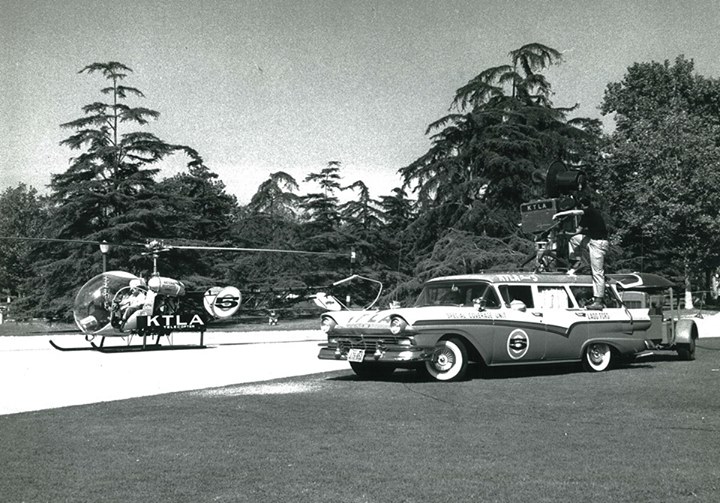
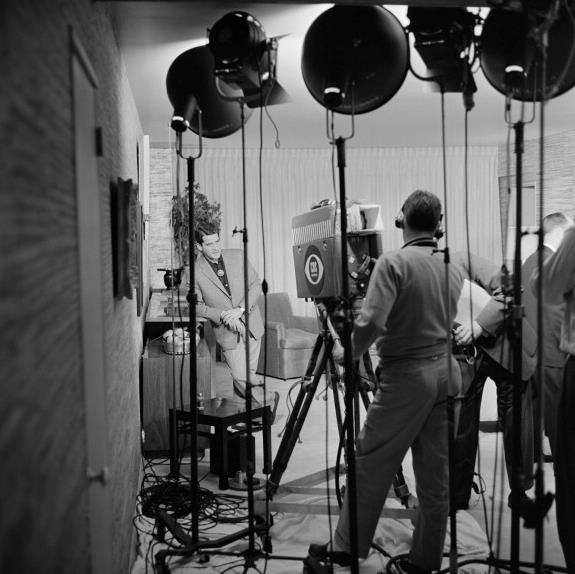
July 4, 1958 KTLA became the first station anywhere to broadcast live from a helicopter. The chopper was called the “Telecopter” and not only did it shoot live pictures, it also was used to bounce live shots from the “Telemobile” to Mount Wilson. The Special Coverage Unit was a self contained Ford station wagon with extra suspension, a live camera on top, CCUs in the back and it pulled a generator with a microwave dish and could broadcast while moving, as it often did, when pressed into coverage service on the Rose Bowl Parades. The link is to a clip of the Bel Air fires in 1961 where both are in service. In the photo we see cameraman Dick Watson with a TK30 in 1959 but in the clip, there is a new Marconi Mark IV on the roof. Thanks to Judy Watson, (former secretary to KTLA’s John Silva and Dick’s wife) for the photo.
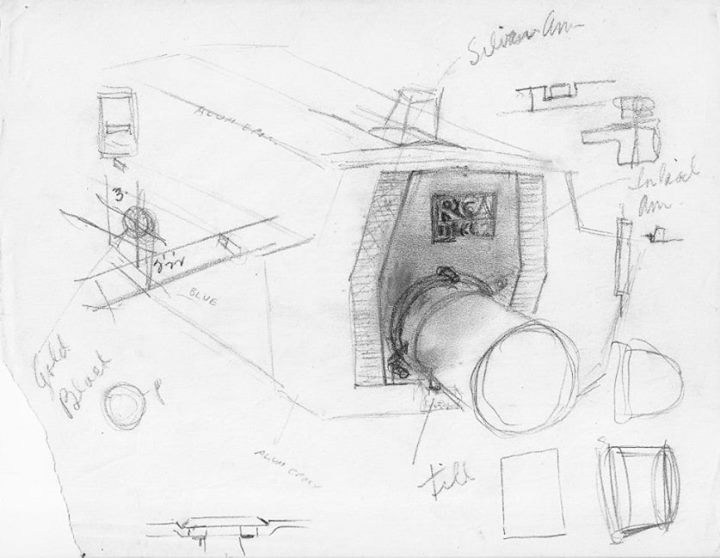
In case you have never seen it, here is the very first sketch of the RCA TK42 camera, the successor to RCA’s TK41 line. This is a scan of the master drawing that I have. It was given to me by RCA’s Harry Wright who designed this, the TK44 and most of RCA’s Telecine equipment. At the link below is the full archive I have from harry with more, first ever sketches.
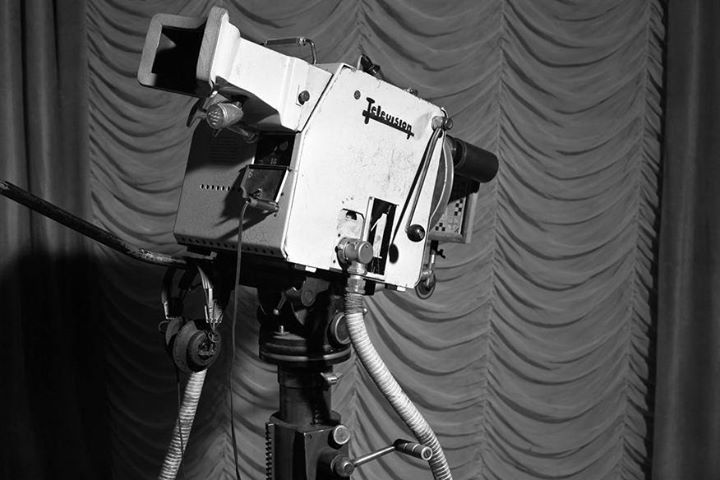
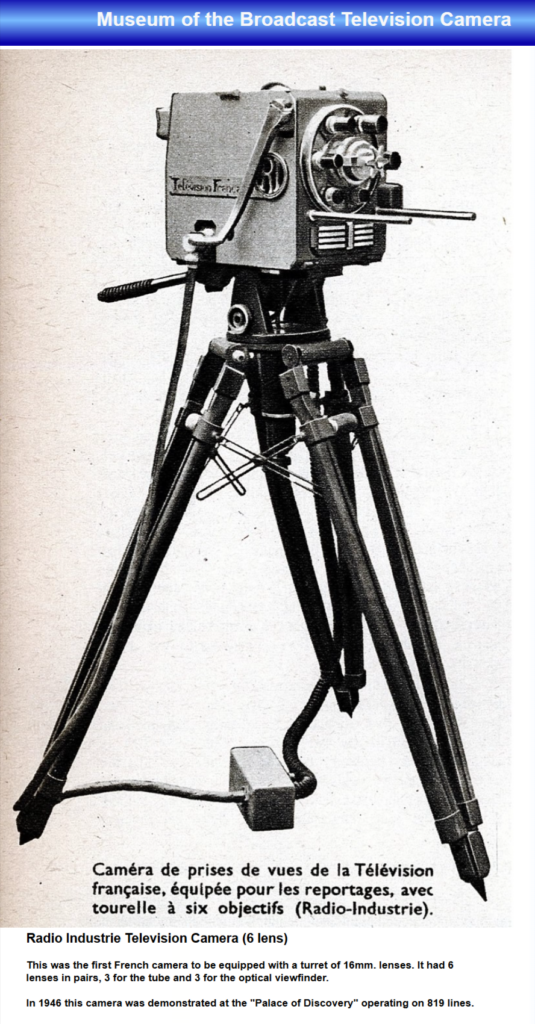
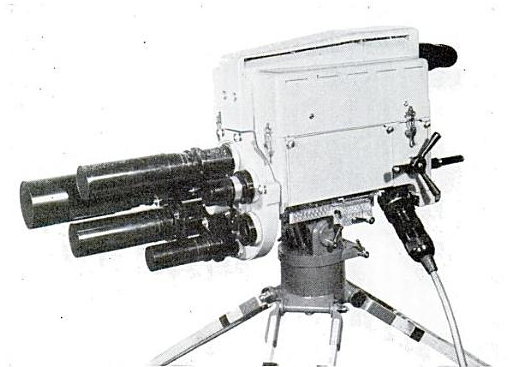
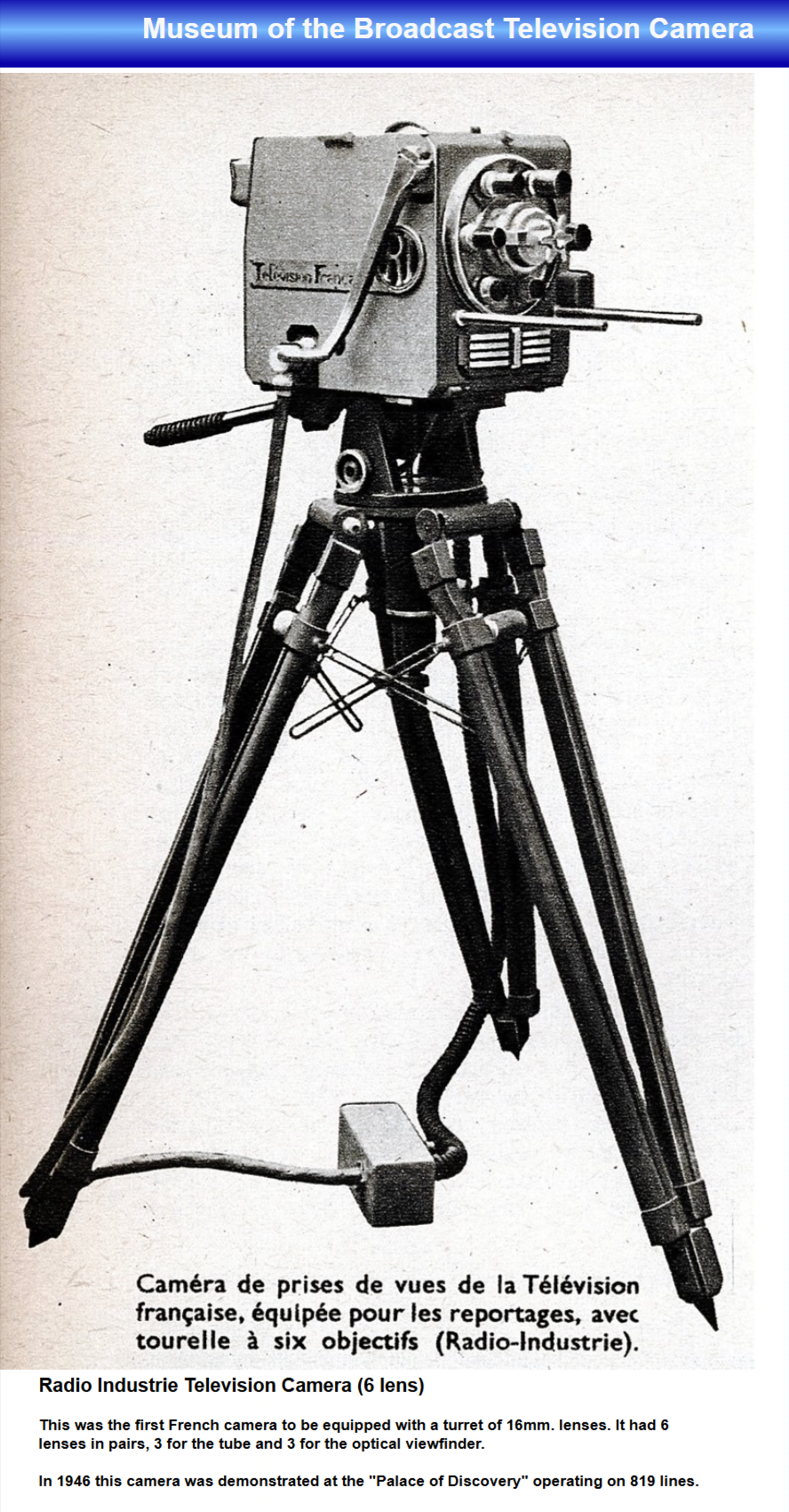
The First Thomson Camera? Close but no cigar…this is the second Thomson camera. Sent to us from our French friend Jorge Delendatti, this is Thomson’s 819-line monochrome model from 1946.
It was made for RTF Television Service (now TF1), and since we don’t have documentation on what kind of tube was used, two things tell me it was an Iconoscope camera. First, the date as Image Orthicons were not in service yet, and second…since it has an optical viewfinder and a turret that has 6 lenses…3 longer ones for the tube and 3 short ones for the viewfinder image, this has to be an Iconoscope camera.
If you look closely at the top image, you can see something quite interesting, but without seeing the front of the camera (below) you just can’t imagine why there is a test pattern attachment on the front. The trick is, the test pattern is for the alignment of the lenses that feed the optical viewfinder and the longer lenses that feed the tube for broadcast. The headphones are receivers only, with the talk back mic located under the viewfinder hood. The T handle on the back is for turret rotation and the long lever on the front is for focus. Interesting cabling too. Many thanks to our friends at https://www.tvcameramuseum.org/
This is a companion to the just posted GE PC 25 photo from Martin Perry, which you see just below this post. I thought you may be interested in seeing the difference between the two. Notice the lifting handles on this model are above the door. On the PC 25, the handles are at the bottom of the camera. The PC 15 debuted in 1958 and the PC 25 around 1965. These cameras were both modeled after the RCA TK41 and had three Image Orthicon tubes. That I know of none of these two GE camera models survive.
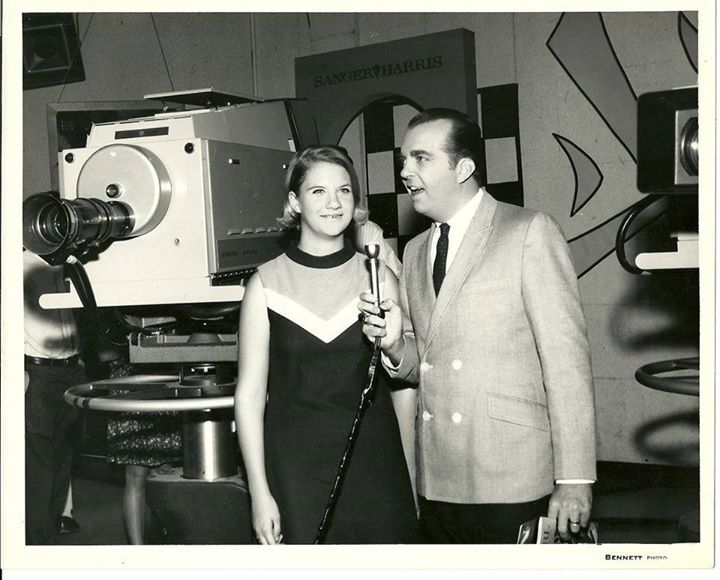
Unfortunately, there are none of these cameras left. The few that were ever made are long gone. This is the second model of GE’s color cameras from around 1965. This, like the it’s predecessor, the PC 15 was a three tube Image Orthicon camera based on the RCA TK41. These weighed in at “only” 220 pounds…the TK41 was close to 300. This rare photo from our friend Martin Perry shows Dallas DJ Ron Chapman with a local teen in 1967 at WFAA.
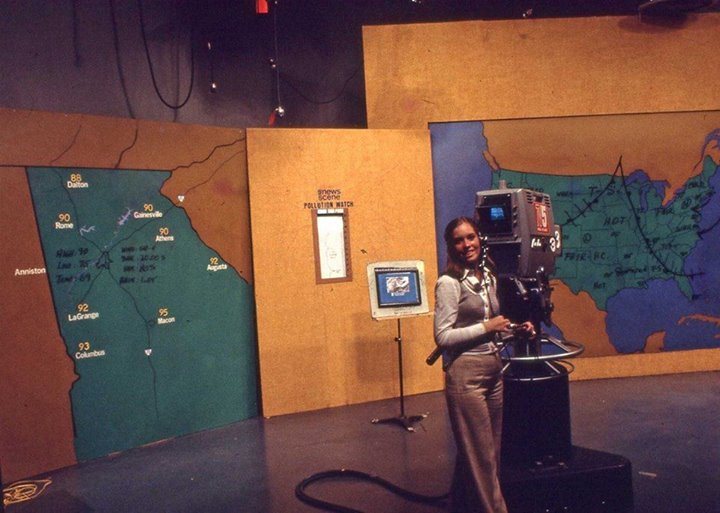
In the summer of 1974, before chroma key walls, virtual sets, or the sleek digital graphics we take for granted today, weather forecasting at WAGA Atlanta was a hands‑on craft — part science, part stagecraft, and part controlled chaos.
The centerpiece of the WAGA weather set was a sprawling wall of oversized maps, each one a physical object that had to be built, mounted, maintained, and updated by hand. The U.S. map we see was framed in what looked like raw plywood but was actually covered in tan felt. Every weather shift began with a ritual: sorting the magnets, checking the fronts, and making sure nothing had fallen off since the last newscast.
Beside the maps sat an easel holding a freshly printed satellite photo — a single still image representing the cutting edge of meteorological technology at the time. In the larger markets, these photos arrived daily, and when they did, they were treated almost like breaking news. Viewers didn’t get loops or animations; they got one snapshot of the planet and a meteorologist who had to interpret it live.
Capturing all of this was one of WAGA’s five Norelco PC‑series color cameras, workhorses of the era and a point of pride for the station. WAGA had invested heavily in production capability when they moved from West Peachtree to Briarcliff Road in 1965, and by the mid‑60s they had even added a sixth Norelco — a rarity for a local station. In those days, WAGA was considered a powerhouse in Atlanta, out‑equipping competitors like channels 2 and 11, which operated with only RCA TK‑42s.
The photo from July 1974 captures all of this: the tactile tools, the craftsmanship, the analog charm, and even the presence of a rare “cameragirl,” a reminder that women were beginning to break into technical roles that had long been male‑dominated.
It’s a snapshot of a transitional moment — the last years before plexiglass maps, before chroma key became standard, before the weather center turned into a digital command hub. Back then, weather wasn’t just presented. It was built. Thanks to Craig Cuttner for the picture.
Thanks to Martin Perry for sharing this remarkable clip. It turns out KTVT in Fort Worth has a surprisingly deep lineage with GE broadcast cameras — and this promo shows it. Even the RARE PE 25!
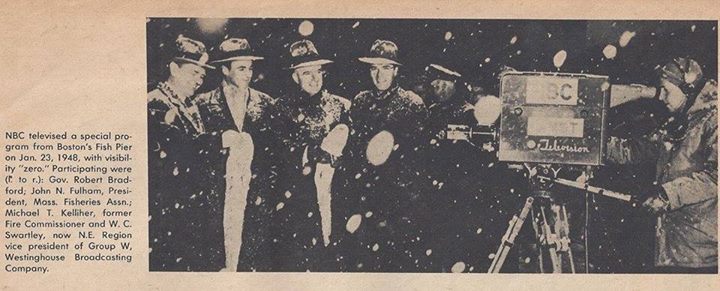
On January 23, 1948, from 2:00 to 3:00 PM, NBC carried out what became the first network television broadcast originating from Boston — a live three‑camera remote sponsored by the Massachusetts Fisheries Association and staged inside the bustling Boston Fish Market.
One of the cameras was equipped with a 40‑inch Zoomar lens, an impressive piece of equipment for the era, though its advantages were quickly undercut when a heavy snowfall began just as the program went on the air. Despite the weather, the production pressed on, staffed and equipped by WNBT in New York, since WBZ‑TV was still six months away from its official sign‑on.
WBZ Radio assisted with the telephone-line transmission, helping route the signal into NBC’s young but growing television network, which at the time linked only four cities: New York, Schenectady, Philadelphia, and Washington, D.C.
Special thanks to Maureen Carney for providing the photograph and background details that help preserve this early milestone in Boston broadcast history.
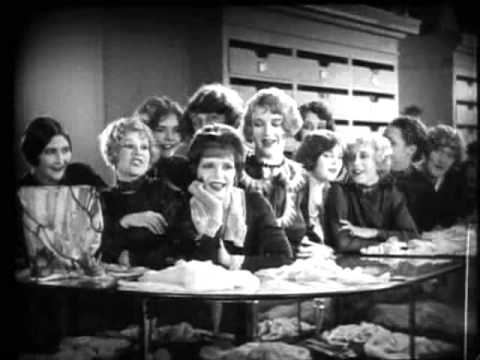
In this clip, starting at 2:00, we see what is thought to be the first ever use of the zoom lens in a cinematic presentation. The film is ‘It‘, starring “The It Girl”, Clara Bow. “It” by the way is “that special something, a unique sparkle of personality and looks that command attention”. The zoom lens was not new when it first made its cinema appearance in 1927. It had been described many decades before and an example was even patented in 1902.
For cinema of the time, it wasn’t an ideal solution, as the cameraman had no way of seeing exactly what he was shooting while in the act of shooting it (true reflex finders didn’t arrive in cine cameras until the Arriflex). One advantage is it needed to only be focused once, and the lens would stay in focus throughout the shot. So, it had uses even in its original form for cinema and was developed and patented by more than one person. Now, the optical elements of a zoom could not be patented outside any novel lens formula, but the mechanism used to zoom could be and was.
The first major patent applied for came from Rolla T. Flora in early 1927 and was granted patent #1,790,232 in January 1931. This was what was used in the ‘It’ movie and was known as the Paramount zoom, and was the earliest cine zoom used. Another was Joseph Walker’s zoom (#1,898,471 applied for September 1929 and granted March 1933). From a profile on Walker, he had been working on a practical zoom for years, but there is no evidence of a useful patent emerging from his work before this, and no evidence this mechanism itself was then useful. He later built what became the RCA Electrazoom for television.
In the years from 1927 until 1932, the zoom lens was essentially exclusive to Paramount. It was used immediately: In the first shot of the 1927 film ‘It’, when establishing the store setting. After the Waltham’s sign is shown, the camera tilts down then zooms to the bustling sidewalk storefront.
In early 1932, a commercially available zoom began to be sold by Bell and Howell. This was known as the B&H/Cooke Varo. Initially it was made to order but later was available as stock. The lens was said to have been acquired by all the major studios and by the government. The lens was also available as a rental to any reputable producer, so it may have found its way to independent producers or a small studio like Monogram. Thanks to Jack Hirschorn for his help with this post.
Before she became the voice that generations would associate with Disney’s Sleeping Beauty, Mary Costa was a Knoxville girl with a remarkable gift. Her path led her to a celebrated opera career — but in 1952, long before the film ever reached theaters, she stepped into a recording booth and brought Princess Aurora to life.
The movie’s journey was epic in its own right. Work on the story began in 1951, animation stretched through most of the 1950s, and the sweeping musical score — rooted in Tchaikovsky’s ballet — was recorded in 1957. When Sleeping Beauty finally premiered in 1958, it became the last Disney feature created with hand‑inked cels, closing the book on an era of painstaking artistry.
And here’s a small delight: the name “Aurora,” shared by both the princess and the old model‑kit company, means “dawn” in Latin.
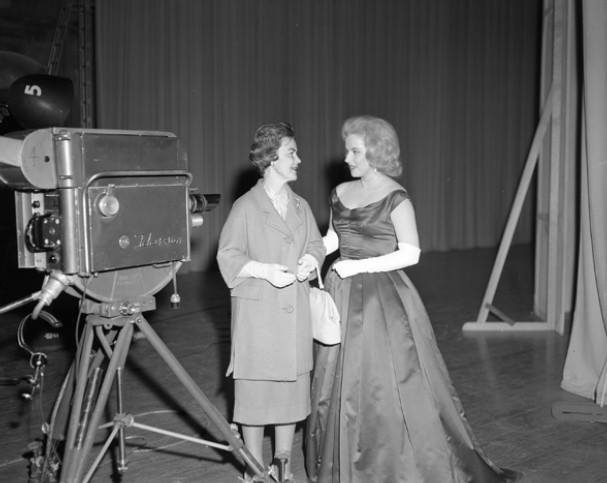
In the photo, Costa (right) stands beside Mary Starr, a familiar face to Knoxville television audiences in the ’50s and ’60s, captured during one of Costa’s hometown visits.
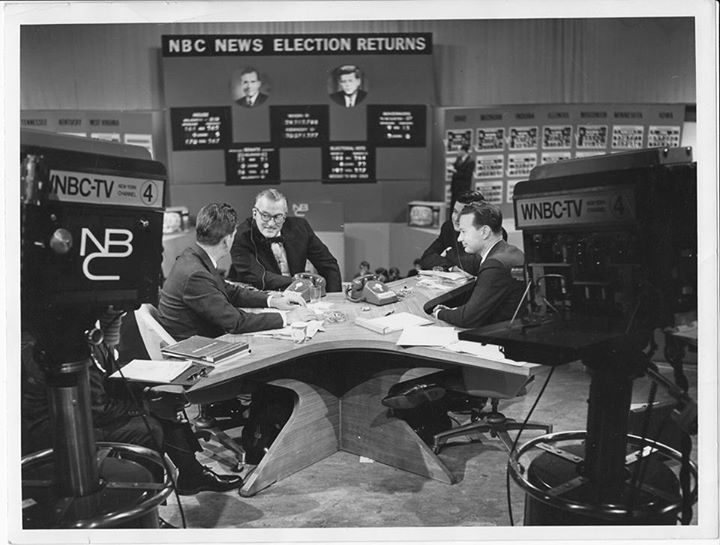
YES, because it is very early in the morning and the TODAY Show is starting and that makes for a very rare image! These four very familiar NBC talents work at different “ends of each day”, yet here they sit beneath the glow of studio lights: (l-r) Chet Huntley, Dave Garroway, Frank Blair, and David Brinkley. It is election night and NBC’s correspondents across America have been covering the event all night, nonstop since the polls closed— the kind of night when American television news grows taller, louder, and more certain of its purpose.
Before the anchor desk in Studio 8H, the cameras loom — RCA TK‑10s, marked with the classic NBC “snake” logo. Even for those who lived through the era, seeing that on monochrome cameras still feels slightly out of place.
The photo comes to us courtesy of Ken Johannessen, and like so many images from early broadcast news, it opens a window into a moment when television was still defining itself — still discovering how to cover a nation choosing its next president.
To see the video from which this image came, take a look at this clip from that night, cued to exactly the right spot.
OH, AND BY THE WAY…Something small but interesting that jumped out at me were the two Nifty notebooks resting on the desk. A tiny detail, but a perfect artifact of the era — the kind of everyday object that instantly transports you back to the early 1960s. Their two‑hole paper, the click‑shut top, the slot for a pencil. I started a grammar school year with one…did you?
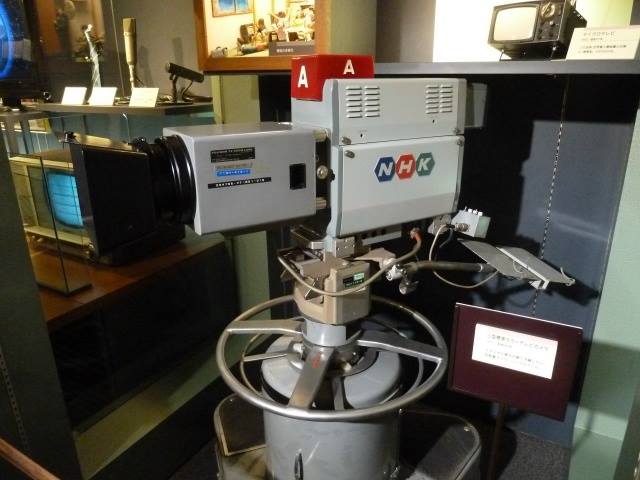
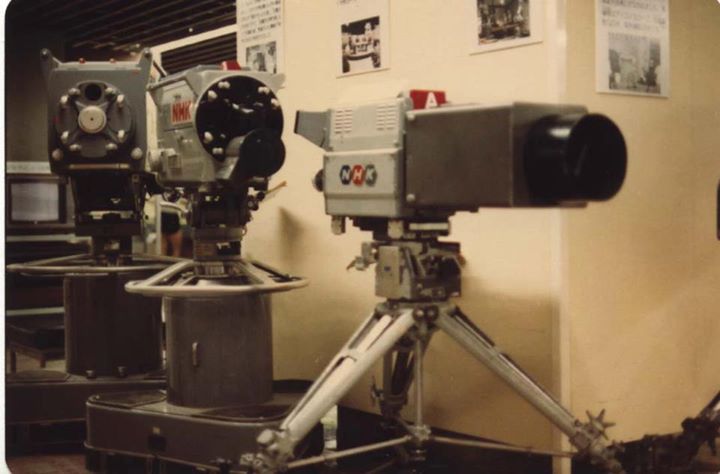
These are Ikegami’s First Studio Color Cameras! Above is the Ikegami TK 301, the granddaddy of the color studio line from Ikegami that was built and delivered to Japan’s NHK Network in Tokyo in 1971. Only a few of these were made and they all went to Japan’s NHK Television for real world field testing and when some bugs were found (imagine that!?), Ikegami did a running engineering update which included internal and external changes.
Within a year, they gave the camera a smaller tally light as you see below and changed up some of the bulky front casting around the lens block; inside, they updated internal boards and gave the camera a new name…the Ikegami TK 301AS. The S stand for small tally variant and was used only in Japan. Everywhere else, it was the TK 301A and there was a lot of demand in Australia and the far east for a new color television camera.
Thanks to Jerome Halphen from Paris, France who made a trip to the NHK Museum and took over 120 photos. I’ve posted most of them on the site and in the bottom photo, in case you were wondering, the cameras behind the Ikegami are both Toshibas.
This first venture studio camera debuted in 1971 and made the name Ikegami synonymous with cameras. The TK 301A was used extensively in the Sapporo Winter Olympic Games in Japan.
Ikegami was busy developing it’s ENG line with the HL 33 debuting in 1973 and the HL 79A in 1979. Their experience with these lead them to the studio sized HK 312 in 1981. With the introduction of the 312, came the change from the TK designation to HK (Handy Kamera) and of course the HL stands for Handy Lookie.
For a look at the TK 301A in studio in Australia, here’s the video.
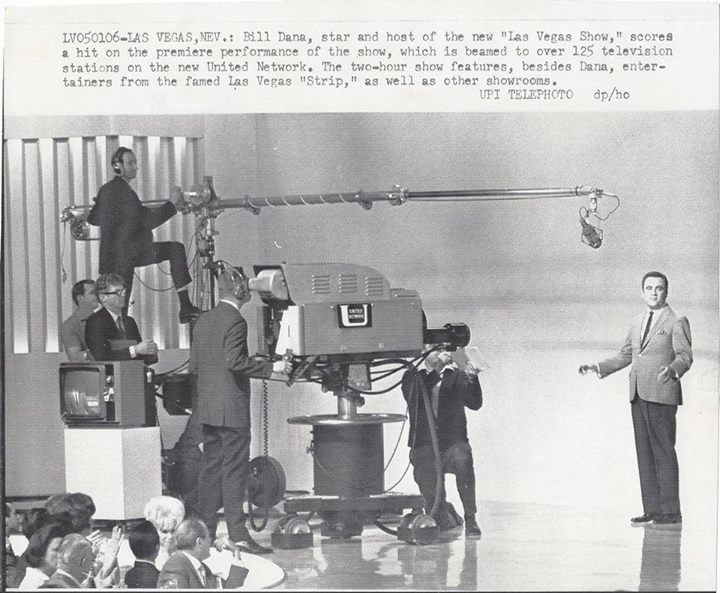
The Overmyer—later United—Network remains one of television’s most fascinating near‑misses. The photo shared by Maureen Carney captures comedian Bill Dana, famous for his José Jiménez character, hosting the network’s flagship program The Las Vegas Show. Beginning May 1, 1967, the two‑hour late‑night broadcast originated from the Hotel Hacienda and aired on 106 stations across the country.
The network itself was conceived as a true fourth competitor to ABC, CBS, and NBC, offering eight hours of daily programming with UPI supplying news. But the dream collapsed almost as quickly as it launched. Within a month, the cost of leased AT&T transmission lines—staggeringly expensive “ad hoc” network circuits—overwhelmed the operation. The ambitious venture folded abruptly and paychecks failed to arrive.
The network’s founder, self‑made millionaire Daniel H. Overmyer, had already been forced to sell a controlling interest before the launch, though he remained the largest shareholder. The new ownership renamed the venture The United Network, but even with promising early reviews for The Las Vegas Show, the financial strain proved fatal. Stations carrying the program were mostly CBS affiliates—comfortable airing it because CBS didn’t program against The Tonight Show.
Plans also existed for Continental Football League broadcasts, UPI news, and even a Bible‑themed cartoon to open the lineup. But when the investors realized the June AT&T line lease alone would cost $400,000, they chose to walk away, reportedly taking a tax write‑off instead of pushing forward.
Today, only scattered promotional photos, print ads, and a few surviving clips hint at what the United Network attempted to build. It remains a brief but intriguing chapter in broadcast history—an ambitious fourth network that flickered brightly for a moment before disappearing almost without a trace.
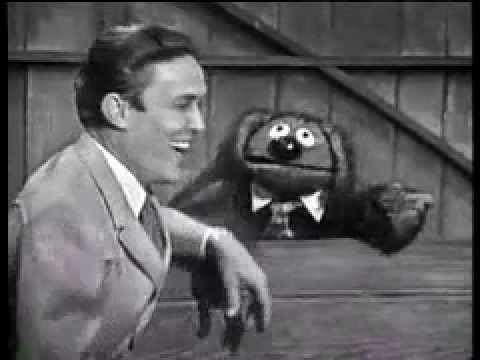
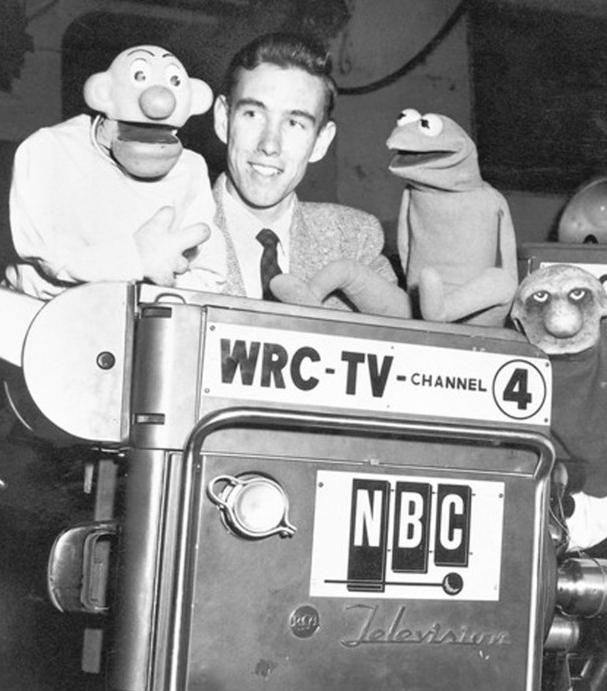
Before the world knew the Muppets as a global phenomenon, Jim Henson and his small crew were grinding away on a local kids’ show in Washington, D.C. From 1955 to 1961. They were on WRC‑TV, doing inventive, scrappy work that hinted at what was coming — but nobody knew just how big it would get.
Across town, over at WTOP, a young Jimmy Dean was hosting a daytime show called Country Style. CBS eventually picked it up nationally as the first version of The Jimmy Dean Show. Henson and Dean crossed paths back then, but it was nothing more than two rising talents bumping into each other in the same city, BUT…
Everything changed when Dean moved to ABC.
That’s where the real collaboration began — and where Rowlf the Dog stepped into the national spotlight. In the clip below, Frank Oz talks about meeting Dean for the first time and about being Henson’s right hand (literally) during the Rowlf sketches. It’s a great reminder of how small and hands‑on the early Muppet team really was.
And Jimmy Dean? Smooth as ever. One of the most naturally easygoing hosts television ever had.
The clip comes from a documentary called The World of Jim Henson, a terrific biography of Henson’s career and the early Muppet years. If you’ve never seen it, it’s worth tracking down.
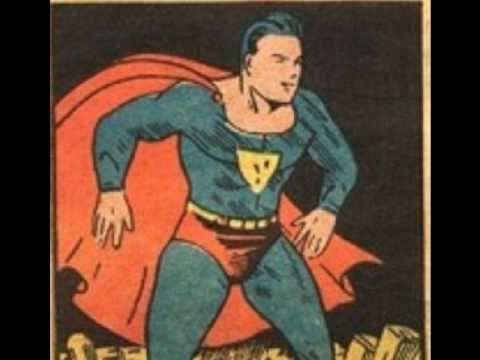
Just for fun… here’s the moment Superman literally took to the air for the very first time — as a magnetic radio wave!
The Adventures of Superman debuted February 14, 1940, on WOR in “Gotham,” and if you’ve ever wondered what pieces of that radio world carried over into the TV series that arrived in 1952 (syndicated first, then picked up by ABC in ’54), this is the clip to hear. The first few minutes of Episode 2 are the real milestone — the first time Superman actually speaks on the air.
Episode 1 was all setup: his trip from Krypton, his arrival on Earth, and young Clark Kent with no speaking part yet. But Episode 2? That’s where the voice of Superman finally shows up… and at about 2:33, you get a surprise that longtime TV fans might not expect.
Most of us know Bud Collyer as the genial game‑show host from Beat the Clock and To Tell the Truth. But before all that, he was the original voice of Superman, and this broadcast is where he first steps into the role.
Give it a listen — it’s a great little time machine back to the moment the Man of Steel first found his voice.
In 1956, Edward R. Murrow’s “eyes and ears” visited Hal March on Person to Person, then one of CBS’s most prestigious and widely watched programs. March was at the height of his fame as host of the smash‑hit quiz show The $64,000 Question, a ratings powerhouse for the network.
Audiences already knew him from his earlier work on The George Burns and Gracie Allen Show and My Friend Irma, but Person to Person placed him in the elite company of cultural figures spotlighted by Murrow.
Although the later quiz‑show rigging scandals centered on Twenty One and Dotto, the fallout swept across the entire genre. By 1958, congressional scrutiny and public distrust had grown so intense that most of television’s big‑money quiz shows disappeared from the air, abruptly ending the brief but explosive era that had made March a household name.
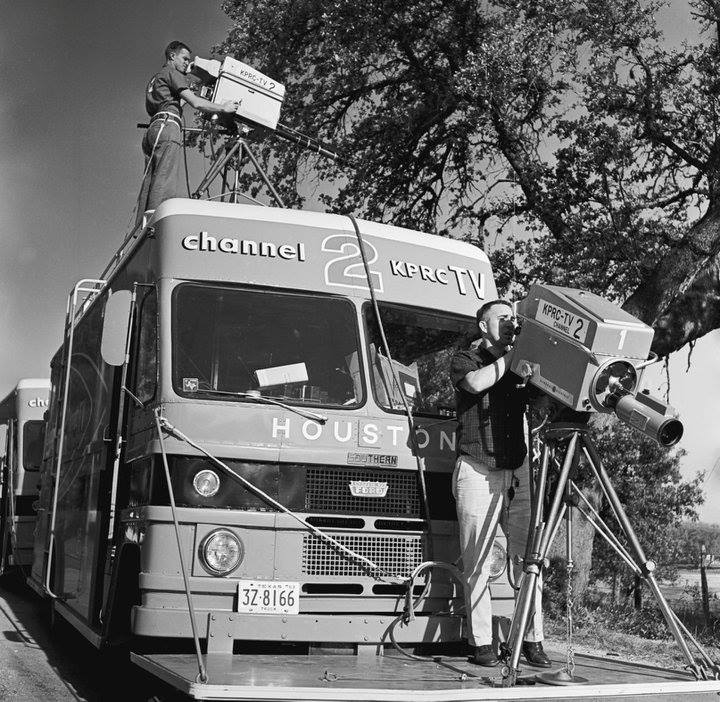
In 1963, KPRC‑TV in Houston deployed two advanced mobile television units that were custom-built for them by Southern Coach. Usually when stations in the west bought new GE cameras, the opted out of all the RCA equipment. Southern Coach became the logical next step for broadcasters who required expanded interiors, greater equipment capacity, and more flexibility than the factory RCA units could offer.
These particular trucks were photographed during the taping of an NBC network special at the ranch of then–Vice President Lyndon B. Johnson in the summer of 1963. The assignment demanded full remote‑production capability in a rural setting, and KPRC’s new units delivered: air‑conditioned workspaces, increased rack room, and the ability to support multiple camera chains, intercom, and switching in the field.
Visible in the images from that day are two key members of the KPRC remote crew. Camera operator Rob Middleton is positioned on the roof of the truck and on the forward platform, engineer John Douglas is working behind a GE PC‑11, one of the station’s primary black‑and‑white cameras during this period. Now that the Vice President was from Texas, they were smart to get into remote ability with style. New trucks, an NBC affiliation and seasoned personal made KPRC one of the most technically capable stations in the west at the dawn of the modern remote‑television era.
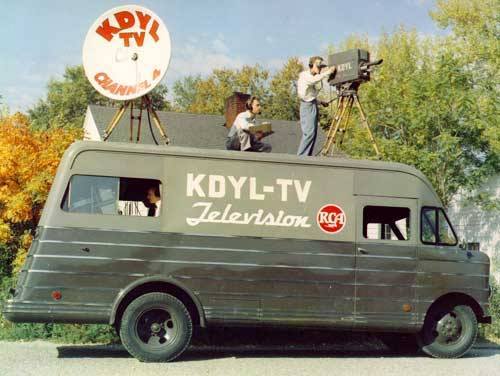
If you worked in local television in the late ’40s or early ’50s, chances are you remember these…the RCA TJ‑48. It wasn’t just another piece of gear — it was the moment local stations finally got a purpose‑built mobile unit instead of the homemade specials everyone had been cobbling together out of buses, bread trucks, and whatever rolled into the station’s back lot.
When RCA introduced the TJ‑48 in 1948, it came with a price tag of $9,000 — which means today, the unit would land north of $123,000. For a small or mid‑market station just getting its footing in the postwar boom, that was a serious investment. But it bought something priceless: a real, engineered‑from‑scratch remote truck that didn’t require a staff engineer with a welding torch and a prayer.
Inside, the TJ‑48 carried the full complement of early postwar RCA field gear, laid out in a way that finally made sense for crews who had to work fast and work small. And RCA didn’t let it sit still — by 1950, the interior electronics were updated, and the improved package became the TJ‑50, the next step in the line.
Before this? RCA had only built 3 big, custom remote trucks for NBC’s Iconoscope cameras back in the 1930s — beautiful machines, but none of them ever went to competitors. If you weren’t NBC (owned by RCA), you were on your own. That’s why the TJ‑48 mattered: it was the first time local broadcasters could buy a standardized, factory‑built mobile unit, ready to roll out of Camden and straight into parade coverage, football games, political rallies, and county fairs.
The TJ‑48 didn’t just fill a need — it set the template. It showed RCA that local stations were hungry for real field capability, and it proved that remote production wasn’t just a network luxury. It was part of the everyday life of American television.
For a lot of stations, this little truck was where their remote story truly began.
If you want to understand where British television engineering stood in the early 1950s, the EMI C.P.S. Emitron is the camera that tells the story. This wasn’t just another post‑war studio box — it was the first generation of British cameras built around the C.P.S. (Cathode Potential Stabilised) Emitron tube, a major leap forward from the pre‑war Emitron and Super Emitron designs.
According to the Science Museum Group, EMI began developing the CPS tube before WWII, but it wasn’t finished until after the BBC restarted service in 1946. The tube made its first major public appearance at the 1948 Olympics, where it delivered higher sensitivity and a more stable picture than earlier Emitrons. It used an orthogonal scanning geometry — the electron gun scanned at right angles to the target plate.
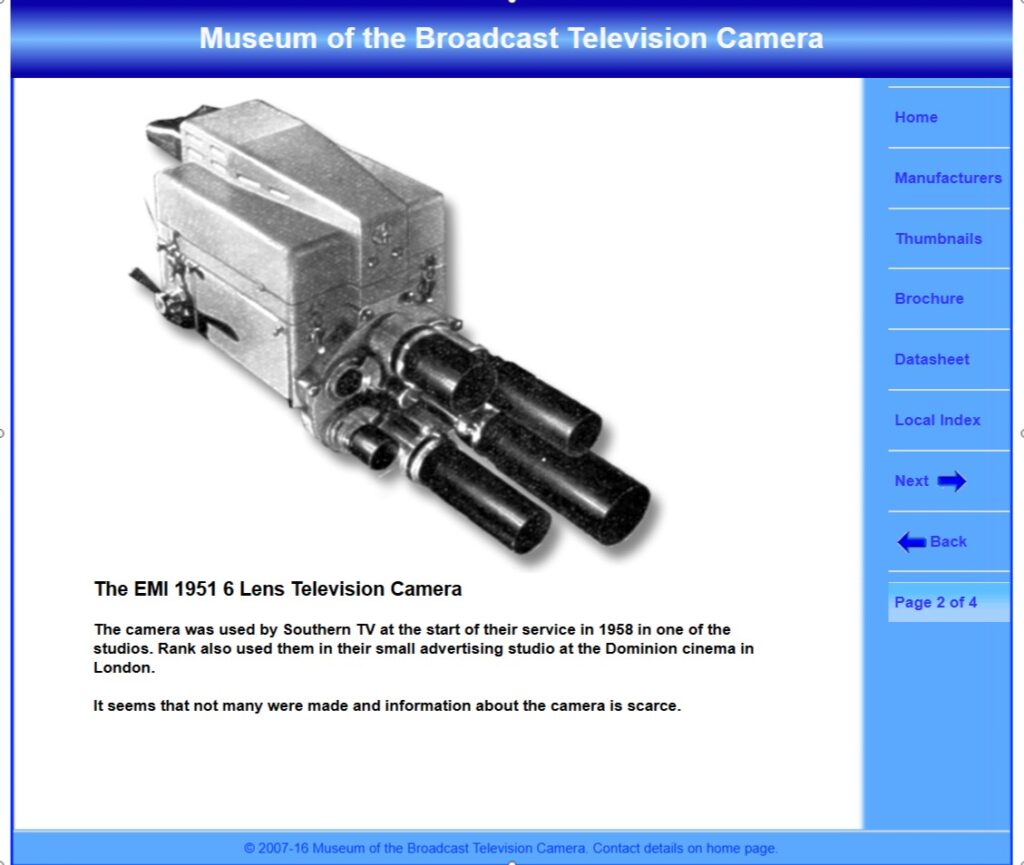
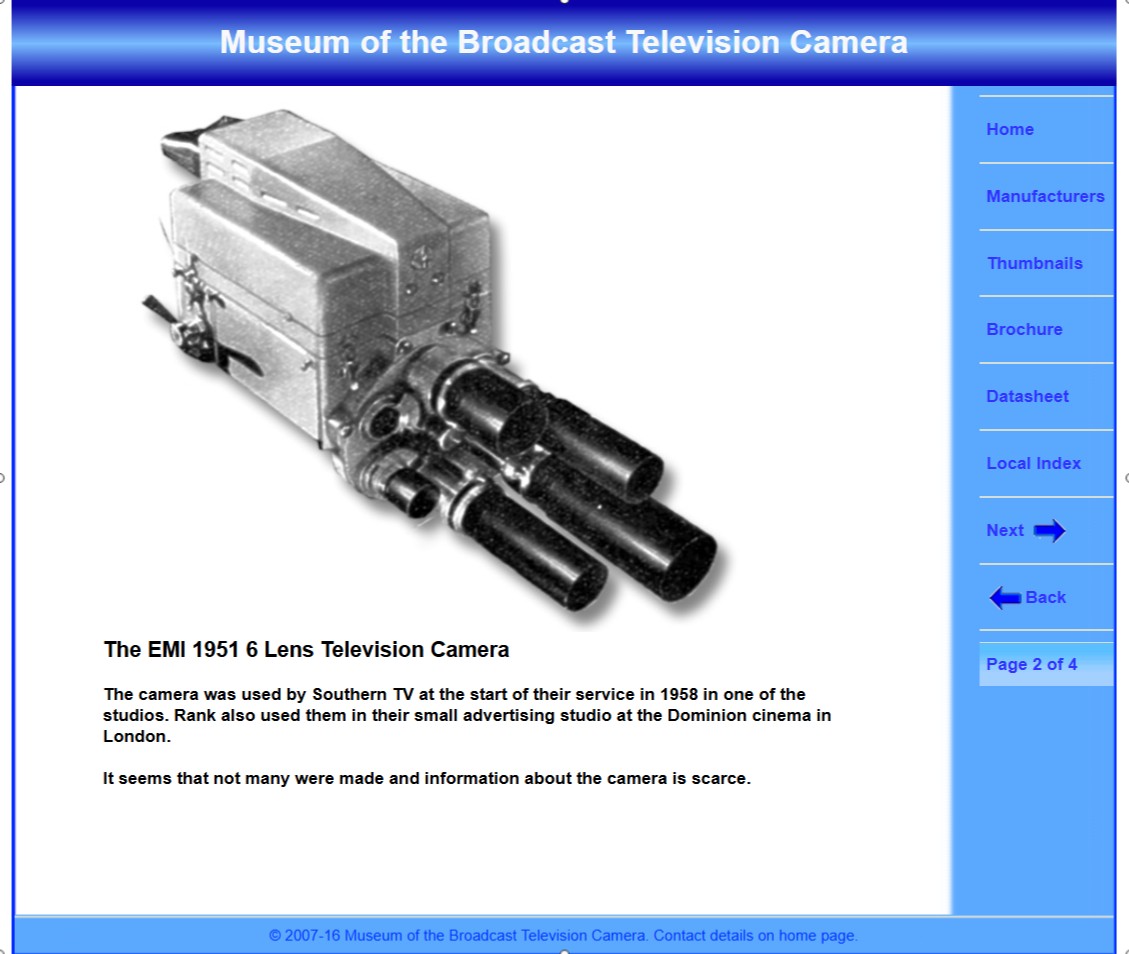
By 1951, EMI had built complete camera systems around this tube. The Museum of the Broadcast Television Cameras documents a 1951 EMI 6‑lens CPS camera, shown at the Festival of Britain and later at the Television Society exhibition. It featured a 6.5-inch viewfinder, remote control capability from an OB van, and export‑ready 625‑line operation — a forward‑looking design for its time.The turret design is one of the camera’s signatures: a six‑lens turret slung low under the front of the camera body, giving it a distinctive silhouette and at the link below to the TVCameraMuseum.org, we get several angles of the camera. Notice in the page we open to, the taking lens seems to be low on the left side, where the lens is off to give us a look.
The CPS tube itself continued to evolve. The TV Camera Museum notes that the 5907 CPS Emitron tube — a later refinement — added a mesh for stability under high light levels and was used in industrial and special‑purpose cameras. They also document BBC use of CPS‑based cameras in difficult locations, including submarine broadcasts.
So, the 1951 CPS Emitron sits at a very specific moment in broadcast history: post‑war British television rebuilding itself, adopting a new tube architecture, and trying to keep pace with the explosive American Image Orthicon era — but doing it with its own engineering philosophy.
That I know of, none of these cameras survived, but the independent museum sources confirm its specs, its public exhibitions, its tube lineage, and its place in the evolution of British TV technology.
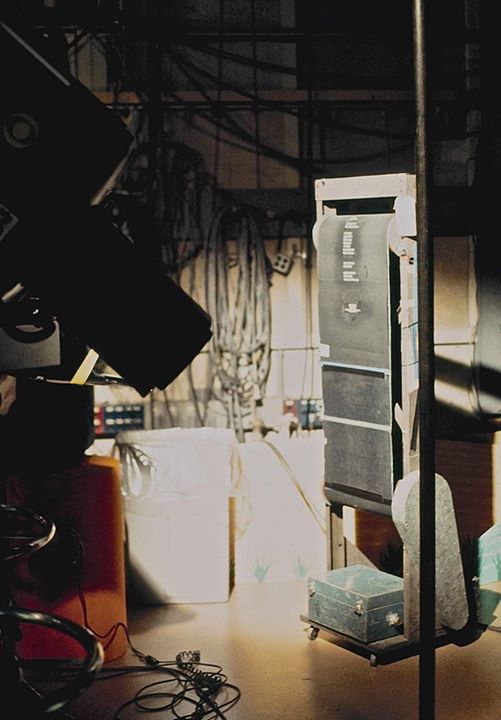
This photo taken in Studio 45 shows the ’60 Minutes’ credit roll board around 1973. This is how it was done in “the old days”. Thanks to Glenn Mack for the photo.