- Home
- TV History
- Network Studios History
- Cameras
- Archives
- Viewseum
- About
Skip to content
Posts in Category: TV History
Page 97 of 135
« Previous
1
2
3
4
5
6
7
8
9
10
11
12
13
14
15
16
17
18
19
20
21
22
23
24
25
26
27
28
29
30
31
32
33
34
35
36
37
38
39
40
41
42
43
44
45
46
47
48
49
50
51
52
53
54
55
56
57
58
59
60
61
62
63
64
65
66
67
68
69
70
71
72
73
74
75
76
77
78
79
80
81
82
83
84
85
86
87
88
89
90
91
92
93
94
95
96
97
98
99
100
101
102
103
104
105
106
107
108
109
110
111
112
113
114
115
116
117
118
119
120
121
122
123
124
125
126
127
128
129
130
131
132
133
134
135
Next » First Airborne Color
On January 19, 2014
- TV History
First Airborne Color and First Live Use Of Color Video Tape
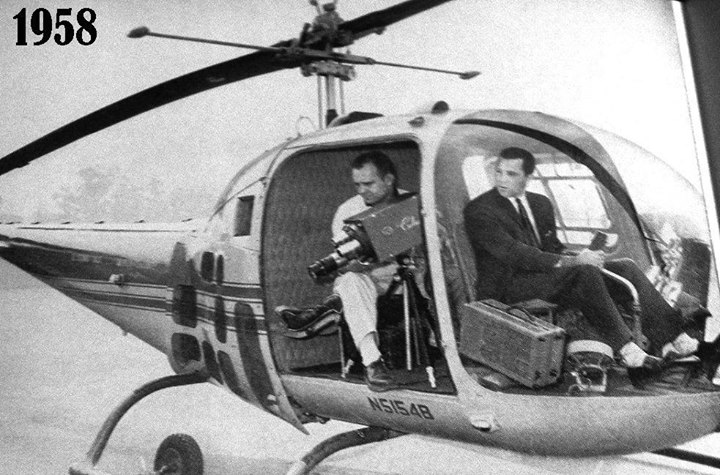
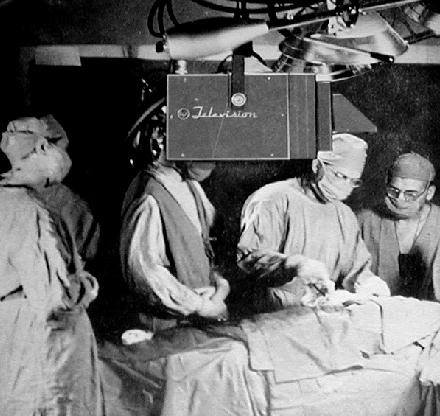
There are several elements to this story, so let’s start with the mystery of the camera itself. Yesterday our friend Lytle Hoover, of RCA’s Broadcast Division in Camden, sent the photo on the left to several television camera collectors. We were trying to identify the RCA color camera in the helicopter and after a few back and forths, Lytle found the rare photo on the right. The right photo is of an early version of the RCA color medical camera and is probably the prototype and probably built in late 1956. In late 1957, several units of the final design were in use at teaching hospitals. Those color medical cameras looked like large TK11s, complete with the side handles but no viewfinders. They were called RCA TK45s but are not to be confused the the TK45A studio camera that came along in 1973. Now, on the next part…where it was used. Newspaper reports describing the upcoming color coverage of the 1958 Rose Parade by NBC mentioned a color camera that would broadcast overhead shots from a helicopter. An aerial color shot would be a first. The other fist was the use of color video tape for the first time in a live broadcast. Now, judges pick the winning floats before hand, but back then, the judges voted on the best floats as they came by the reviewing stand. NBC taped the parades floats so they would be able to play back images of the winners after the parade when the judges made their awards.
The Cradle Head Patent
On January 19, 2014
- Archives, TV History
Necessity Is The Mother Of Invention…The Cradle Head Patent
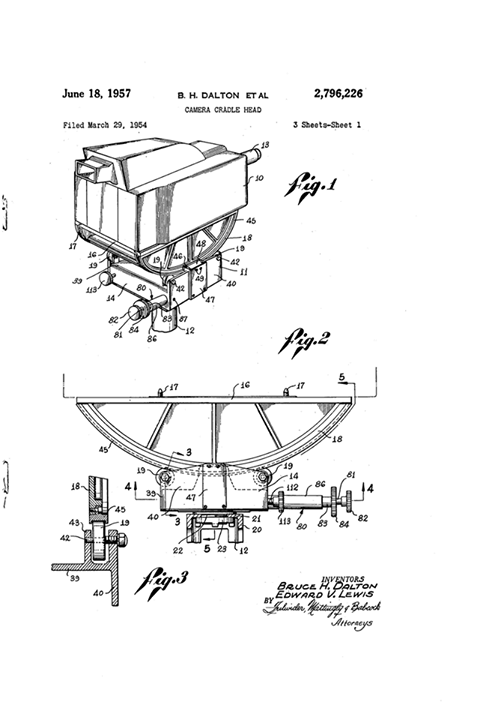
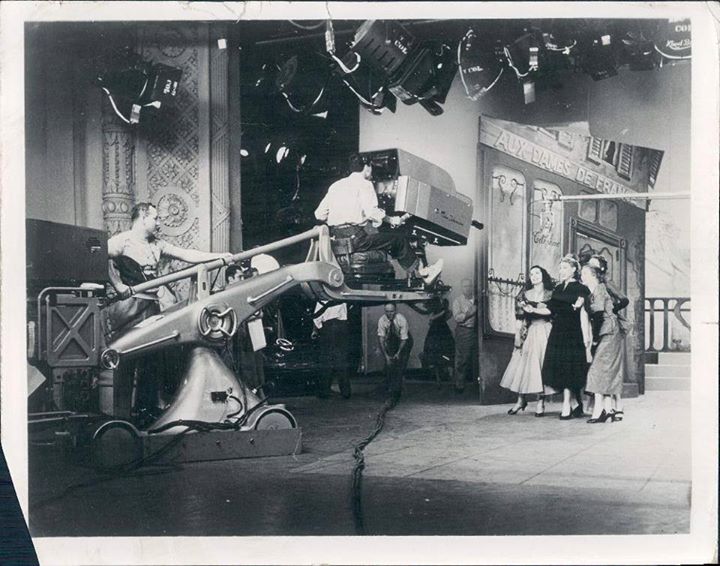
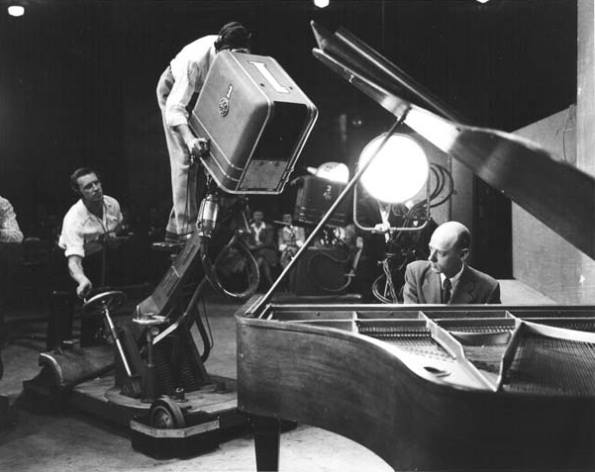
The Fearless Camera Company and RCA had a good thing going… Fearless (later, Houston Fearless) built the support equipment and RCA’s built the cameras and distributed for Fearless. As you can see in the photo on the right, the first experimental TK40 color cameras used the Fearless friction type pan head. The camera was just to heavy for it though, so Bruce Dalton (one of the creators of the TD 1 pedestal) and Edward Lewis came up with the now famous Cradle Head design. Although RCA built 239 TK40/41s, only 215 of these wide bodied cradle heads were made and distributed with the cameras as of 1964, when regular production stopped. In 1966, 24 more were made and all were shipped with the new Houston Fearless Cam style pan heads which you see under most of ABC’s TK41s as they bought 12 of the last 24 made. By late in 54 there was also a narrower cradle head available that fit under RCA’s black and white cameras like the TK11/31. The photo on the right shows one of the first production models of the TK40 being tested at the Colonial Theater.
A Final Goodnight…
On January 18, 2014
- TV History
A Final Goodnight…
Soon Jay Leno will join this list, but for now, here are Walter Cronkite, Douglas Edwards, Johnny Carson, Tom Brokaw, Dan Rater, Peter Jennings, Bob Barker, Larry King, Mary Hart, Oprah and Regis signing off for the last time. Enjoy.
http://www.youtube.com/watch?v=N3MhrWM0__M
From Walter Cronkite to (just recently) Regis Philbin, here is a look back at fond television farewells over the last three decades, though some of them stil…
One Of My Favorites
On January 18, 2014
- TV History
One Of My Favorites
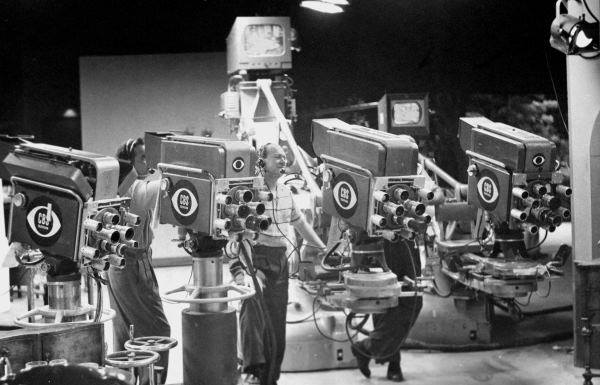
Here’s a bank of RCA TK11s at Television City going through the registration process. They are probably am out of range grey scale chart. No, there are not 10 lenses per camera…only four, but there are six small “face lights” on the front of each unit. Even with the best overhead lighting, there are always shadows and to help eliminate the chin, nose and eye shadows, these custom light racks were installed to help brush them out on close up and medium shots. Unlike their brethren in NY, who opted for the cue card/gaffer tape viewfinder hoods, the west coast cameras at CBS and NBC had custom viewfinder hoods built in their own shops. Go figure.
In The Beginning…CBS STUDIO CITY
On January 18, 2014
- TV History
In The Beginning…CBS STUDIO CITY
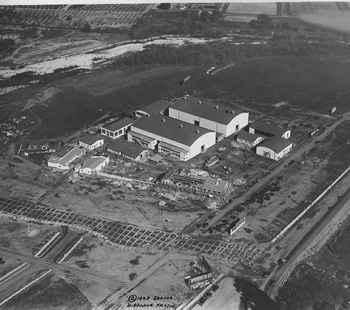
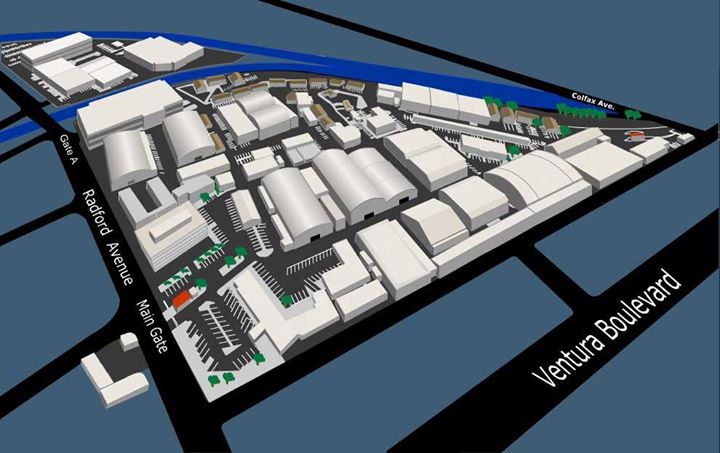
Below left is the original property as it looked in 1926 as the Mack Sennett Studios. On the left, a rendering of how it looks now and at the link, a guided tour via an animated map. Here’s the history. http://www.cbssc.com/map.htm
The year was 1926 and plans for a new city in the San Fernando Valley were being developed. It began with the purchase of a 50 acre lettuce ranch at the corner of Colfax Avenue and Ventura Boulevard, along with a 300 acre ranch located at Laurel Canyon. During this time, “King of Comedy” Mack Sennett, known for his two-reelers and the Keystone Kops, was looking for a new studio location. A deal was struck and in 1928 Mack Sennett Studios opened and the surrounding area became known as Studio City. At this time the Studio consisted of one office building, a projection room/film editing building, a film library, a two-story dressing room building attached to a large sound stage, a wardrobe building, garage, and a stage with an inground swimming pool. With the advent of sound in 1929, Sennett was the first producer to use RCA equipment, with which he produced a bunch of singing short subject films with a young unknown named Bing Crosby.
In 1933 the Great Depression forced Sennett into bankruptcy and the Studio became an independent production facility. Mascot Pictures, under the direction of Nat Levine, became one of the principle tenants and for the next two years the Studio was known as Mascot Studios. Mascot produced the Saturday matinee serial which always ended with the heroine left tied to the railroad tracks as a speeding train came hurtling toward, interrupted by “continued next week.”
In 1935 Mascot Pictures, Monogram Pictures and Consolidated Film Industries joined with several other independent producers and became known as Republic Studios. By then there were six sound stages and several more support buildings. Republic produced over fifty features a year which starred, among others, legends Roy Rogers, John Wayne, Joan Crawford and Barbara Stanwyck. With the advent of television in the early 1950’s, Republic entered a new medium and produced a number of series. By this time there were twenty-three sound stages and the largest scoring studio in the world.
In 1963 the CBS Television Network entered into an agreement with Republic Studios whereby CBS became the major lessee and the facility was renamed CBS Studio Center. By 1967 CBS decided to purchase the studio and long range improvement plans began. The lot continued to grow and throughout the 60’s and 70’s such television classics as Gunsmoke, Big Valley, Gilligan’s Island, Get Smart, My Three Sons, Bob Newhart, and Mary Tyler Moore were produced at the Studio.
In July of 1982 CBS and 20th Century Fox Film Corporation formed a joint venture which included ownership and operation of CBS Studio Center, and for the first time in almost twenty years a new name appeared on the sign above the main gate, CBS/Fox Studios. Then in 1984 Fox sold its interest in the Studio to MTM Enterprises and the facility became CBS/MTM Studios. Shows produced on the lot during the 80’s included Roseanne, Different World, Thirtysomething, St. Elsewhere, Newhart, Hill Street Blues and Falcon Crest.
CBS acquired MTM’s interest in the Studio in 1992 and once again the CBS Studio Center sign appeared at the gate. Seinfeld, Grace Under Fire, 3rd Rock from the Sun, Cybill, and Caroline in the City are just a few of the shows which called CBS Studio Center home during the 90’s. Features such as Father of the Bride 2, Dr. Doolittle, and I Love Trouble were also filmed on the Studio lot.
Some of the more recent hit shows produced on the lot of CBS Studio Center are, CSI:NY, The Defenders, The Talk, Hot in Cleveland, According to Jim, Will & Grace, Big Brother and That 70’s Show.
Today the Studio continues to flourish and grow. CBS Studio Center is now home to a brand new Broadcast Center which houses CBS2 and KCAL9.
The Fearless Camera Pedestal Patent
On January 17, 2014
- Archives, TV History
The Fearless Camera Pedestal
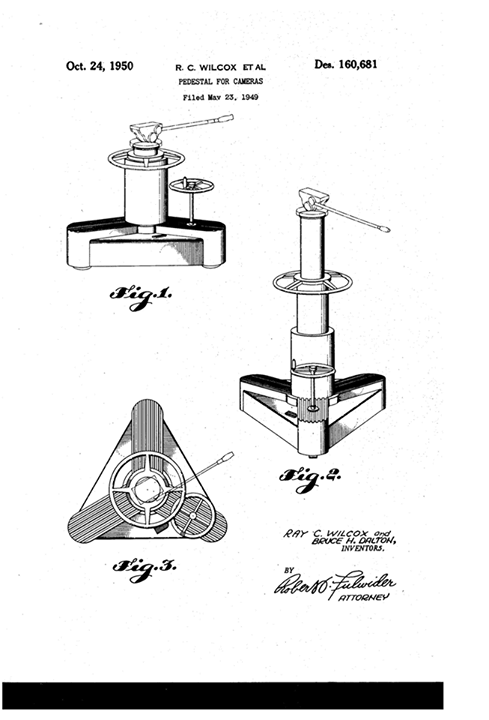
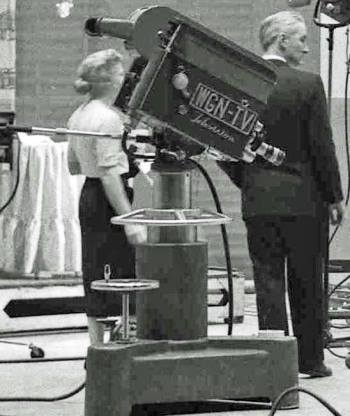
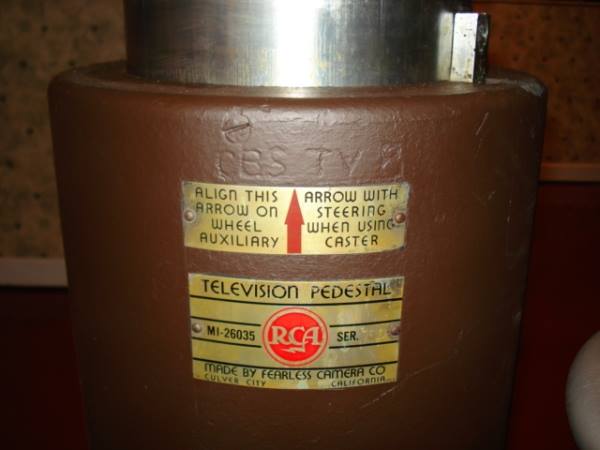
May 23, 1949 Ray Wilcox and Bruce Dalton submitted their patent application for television’s second ever camera pedestal, but the first to use the now standard center steering ring. The patent was assigned to their employer, the Fearless Camera Company in Culver City, CA. The up and down action for the column was achieved by turning the base mounted crank wheel. This quickly became the industry standard and was known by it’s model number, the TD 1. RCA was the distributor.
Who Knew? The Story Of Kay Thompson & Andy Williams
On January 17, 2014
- TV History
Who Knew? The Story Of Kay Thompson & Andy Williams
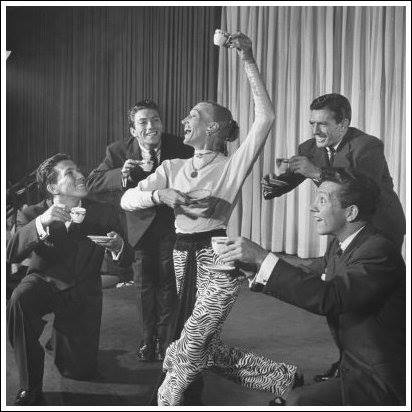
Meet the lady behind Andy Williams…Kay Thompson. Today, some may call her a “cougar”, but back in the 40s, she was a tiger! Andy and his three older brothers—Bob, Don, and Dick, (pictured below with Kay) formed The Williams Brothers quartet in late 1938, and they performed on radio in the Midwest, first at WHO in Des Moines, Iowa, and later at WLS in Chicago and WLW in Cincinnati. Moving to Los Angeles in 1943, The Williams Brothers sang with Bing Crosby on the hit record “Swinging on a Star” (1944). They appeared in four musical films: ‘Janie’ (1944),’ Kansas City Kitty’ (1944), ‘Something in the Wind’ (1947) and ‘Ladies’ Man’ (1947). In 1945, The Williams Brothers were signed by MGM to appear in ‘Anchors Aweigh’ and ‘Ziegfeld Follies’, but before they went before the cameras, the oldest brother Bob was drafted into military service and the group’s contract was canceled. Kay Thompson, a former radio star who was now head of the vocal department at MGM, had a nose for talent and she hired the remaining three Williams Brothers to sing in her large choir on many soundtracks for such MGM films as ‘The Harvey Girls’ (1946). When Bob was done with his military service, Kay hired all four of them to sing on the soundtrack to Good News (1947). By then, Kay Thompson was tired of working behind the scenes at MGM so, with the four Williams boys as her backup singers and dancers, she formed a nightclub act called Kay Thompson and the Williams Brothers. They made their debut in Las Vegas in 1947 and became an overnight sensation. Within a year, they were the highest paid nightclub act in the world, breaking records wherever they appeared. Andy Williams revealed in his memoir “Moon River and Me” that he and Kay became romantically involved while on tour, despite the age difference (he was 19 and she was 38). The act broke up in 1949 but reunited for another hugely successful tour from the fall of 1951 through the summer of 1953. After that the four brothers went their separate ways. Andy and Kay, however, remained very close, both personally and professionally. She mentored his emergence as a solo singing star. She coached him, wrote his arrangements, and composed many songs that he recorded (including his 1958 Top 20 hit “Promise Me, Love” and, later, “Kay Thompson’s Jingle Bells” on his 1964 No. 1 “The Andy Williams Christmas Album”). Using her contacts in the business, Kay helped Andy land his breakthrough television gig as a featured singer for two-and-a-half years on ‘The Tonight Show starring Steve Allen’ (it helped that the producer of the series Bill Harbach was Kay’s former aide de camp). Kay also got Andy his breakthrough recording contract with Cadence Records (the label’s owner Archie Bleyer had gotten early career breaks because of Kay and he owed her a favor). Meanwhile, Andy sang backup on many of Kay’s recordings through the 1950s, including her Top 40 hit ‘Eloise’ based on her bestselling books about the mischievous little girl who lives at the Plaza Hotel in New York. Kay also served as a creative consultant and vocal arranger on Andy’s three summer replacement network television series in 1957, 1958, and 1959. In the summer of 1961, Kay traveled with Andy and coached him throughout his starring role in a summer stock tour of the musical “Pal Joey”. Their personal and professional relationship finally ended in 1962 when Andy met and married Claudine Longet and Kay moved to Rome. Above is a 1969 clip of Kay on ‘The Hollywood Palace’.
Andy Williams…The One And Only
On January 17, 2014
- TV History
Andy Williams…The One And Only
If you didn’t see this show in it’s original run from 1962 through 1971, it’s hard to understand how good he was as a host and singer and how good the show was, in every way. In the next post, I’ll cover some background most us never knew but as for Andy’s big break in television…it came when he was the featured singer on ‘The Tonight Show With Steve Allen’ for two and a half years. In ’59, ’60 and ’61, Williams hosted a summer replacement show on NBC which was well received and those shows set the stage for him. In the fall of ’61, ‘Breakfast At Tiffany’s’ was a huge hit and with it, ‘Moon River’ by Johnny Mercer and Henry Mancini. Andy Williams sang it at the 1962 Academy Awards show and has “owned” the song since. Each episode of the show opened with him singing eight bars of the song. The glowing sentiment and fond memories most people have for both Andy and his show is something you had to be there for to really appreciate.
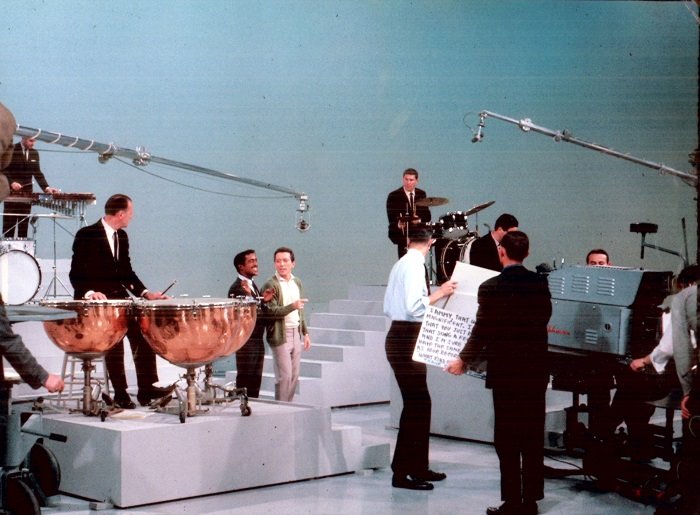
Above is a still from one of Sammy Davis Jr.’s appearances on the show. There is a low quality video of this scene out there, but here is another clip of Sammy and Andy that pretty much captures the mood and gentle style of the show. Love that TK41 color too!
The Technical Story Of The Hindenberg Crash Audio Recording
On January 16, 2014
- TV History
The Technical Story Of The Hindenberg Crash Audio Report
On May 6, 1937, history was made at Lakehearst, NJ and had it not been for two men from Chicago’s WLS Radio, all we would have is silent newsreel footage of the event. This was more of a human interest story than news, because the German airship was in it’s second year of operation and that’s why there was no live radio coverage. Fortunately, WLS had sent announcer Herb Morrison and engineer Charles Nehlsen to the scene to record the event for playback the next day. Nehlsen was manning the Presto Direct Disc recorder they had carried with them on their American Airlines flight to and from Chicago. The whole program covered four, 16″ discs recorded at 78 rpms. On their return to Chicago, they were edited to two 12″ discs, and for the first time ever, a recorded news event was broadcast on network radio as NBC replayed Morrison’s now famous account on both the Red and Blue networks. The edited discs were taken to Chicago’s WMAQ (NBC O&O) for the NBC feed. Below is the link to the famous clip, that long ago was married to newsreel footage of the disaster. The photo at the far right shows an NBC reporter broadcasting live from the scene the next day via a portable radio unit. Above is Herb Morrison, next, the Presto Disc Recorder, next one of the actual edited discs.
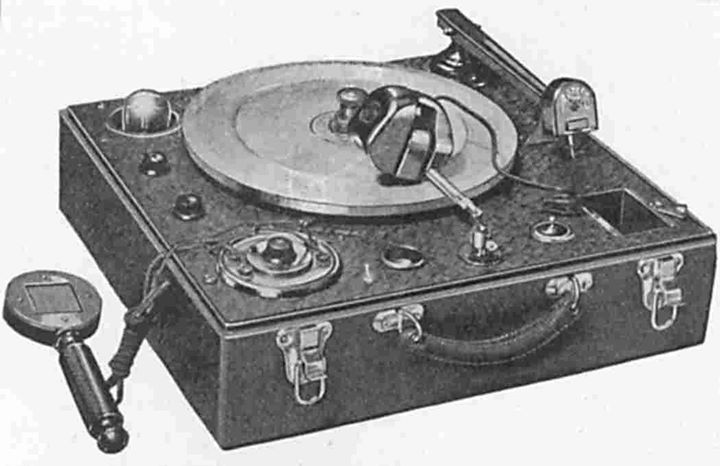
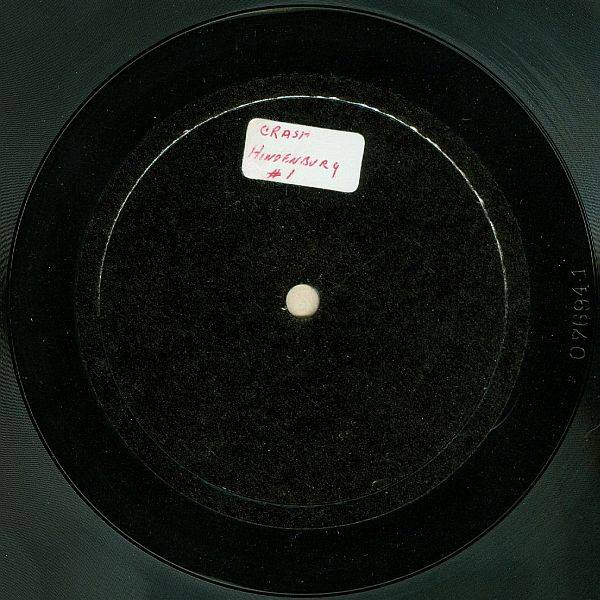
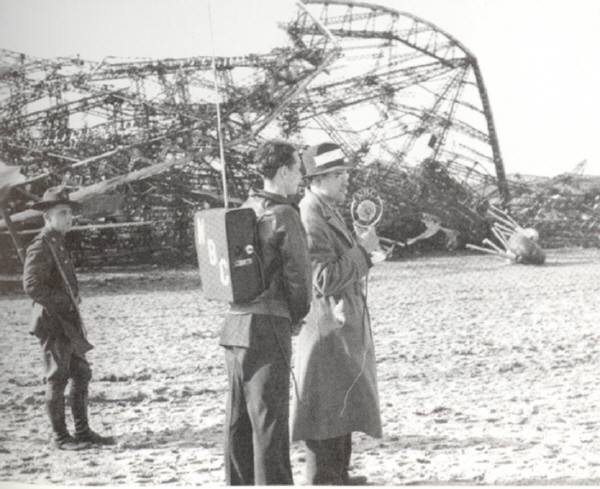
Television’s First Camera Pedestal…November 1936
On January 16, 2014
- Archives, TV History
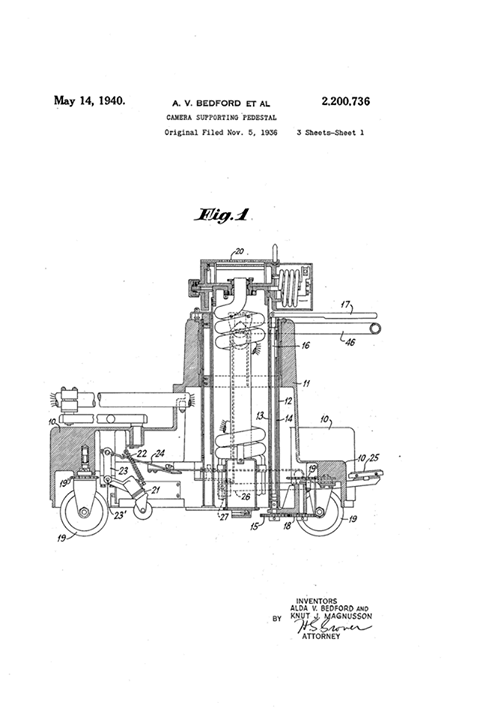
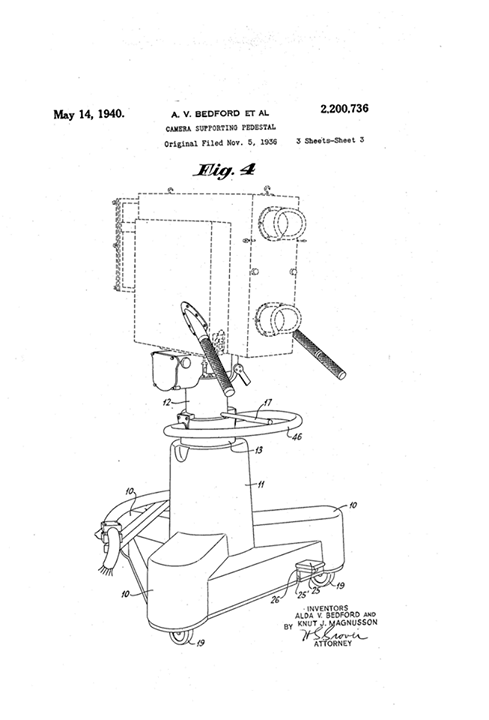
Designed by Alda V Bedford and Knut J Magnusson, the patent assignment went to RCA which I think was their employer. It was a surprise to me that the lifting column is powered by an electric motor located in the base, and the up and down action is controlled in the left panhandle of the camera.
Another interesting feature is the internalization of the camera cable which as you can see in the drawing on the right, fits inside the column and is threaded to the bottom center of the camera, passing through the pan head. Unlike today’s peds, there is no steering ring. The ring you see is for pushing and pulling only. If you look closely at the schematic on the right (17) you can see a lever on top of the ring…that is what sets the wheel direction.
This ped has crab steering only and the foot pedal on the base is for a forth castor wheel that comes down so the pedestal can pivot to change the base position under the camera. The Fearless TD 1 pedestal developed in 1949 had this castor wheel also but added the steering ring and a manual up and down column. That comes tomorrow.
A Pioneer In Every Way…Ernie Kovacs
On January 16, 2014
- TV History
A Pioneer In Every Way…Ernie Kovacs
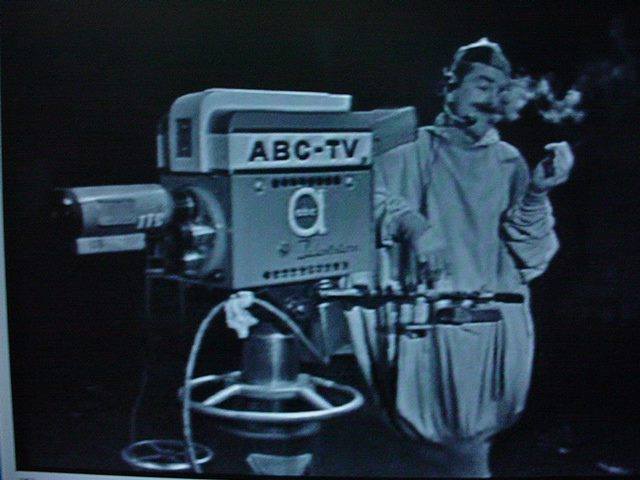
Below is a screen shot from one of his last appearances before his death in a car crash in January of 1962. Beginning in April ’61, Kovacs hosted regular specials on ABC which were considered his best works ever and won an Emmy for his innovative special effects using electronic cameras and video tape. Kovacs got his television start in in 1951 at Philadelphia’s WPTZ (now KYW) and with that two hour morning show (7-9 AM), proved that viewers would indeed watch a show at that hour…a point well taken by NBC’s Pat Weaver who created ‘The Today Show’ a year later. Kovacs was one of only six shows to run on all four networks. At Dumont, he did a late night talk show. At NBC he did several shows including a weekly prime time half hour, a daily late morning show and filled in as a summer replacement for Caesar’s Hour. At CBS, he did two years of mornings at 8:30 -9 and later did six months of a weekly primetime show there. There were times when he was on two networks at once, but back then, so were others like actress Fay Emerson. FYI, the other five shows that aired on all four networks were ‘The Original Amateur Hour’, ‘Pantomime Quiz’, ‘Down You Go’, ‘The Arthur Murray Party’, and’ Tom Corbett, Space Cadet’. The camera is an RCA TK10 with a Zoomar lens painted in ABC’s classic red and white. The lead weights on the pan handle are to balance off the Zoomar.
You Mean Mayberry Isn’t In North Carolina?
On January 15, 2014
- TV History
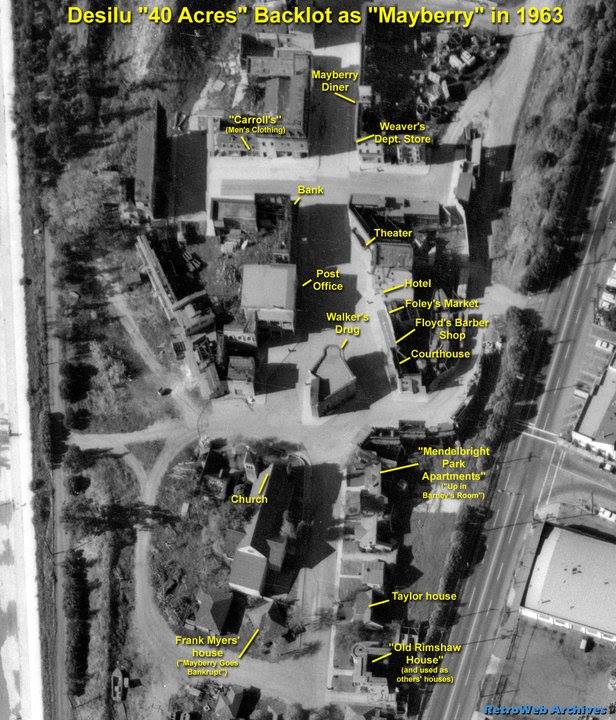
You Mean Mayberry Isn’t In North Carolina?
Sorry to burst your bubble, but here’s an aerial shot from 1963.
WHDH Boston, The Big Move To Color
On January 15, 2014
- TV History
WHDH Boston, The Big Move
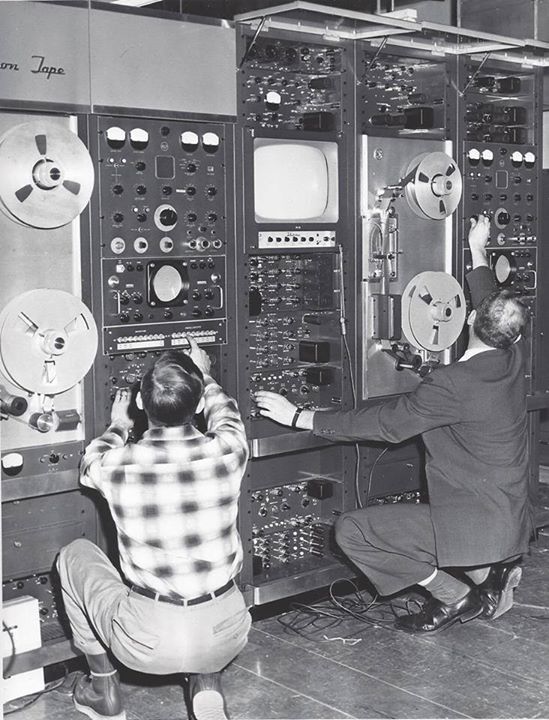
Below left is Keith Jordine of WHDH and on the right is RCA tech John Cimba making ready for the debut of their new color facilities in 1960. The videotape recorder is the RCA TRT 1B, which occupied five rack panels plus one more for color. Thanks to Maureen Carney for the photo.
The 1937 RCA Iconoscope Camera, Patent Diagrams
On January 15, 2014
- Archives, TV History
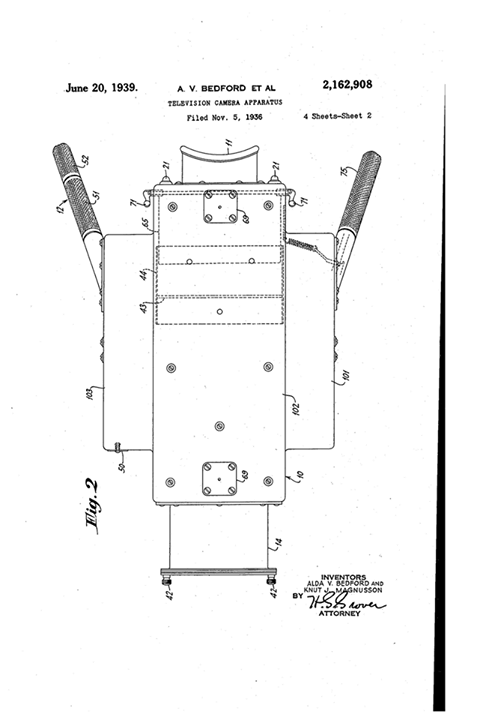
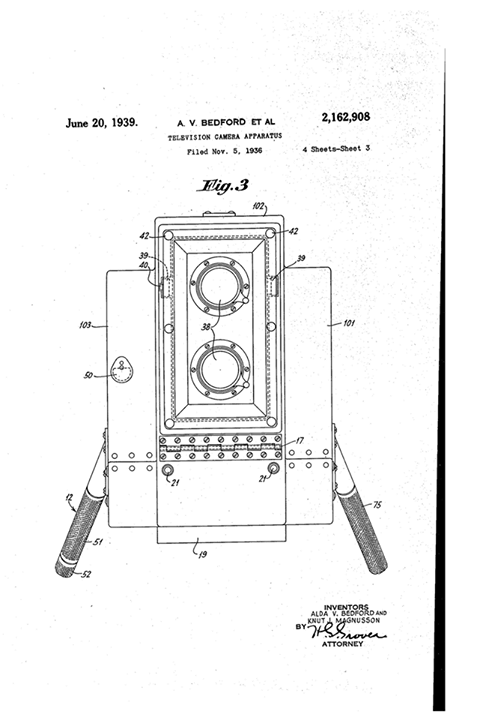
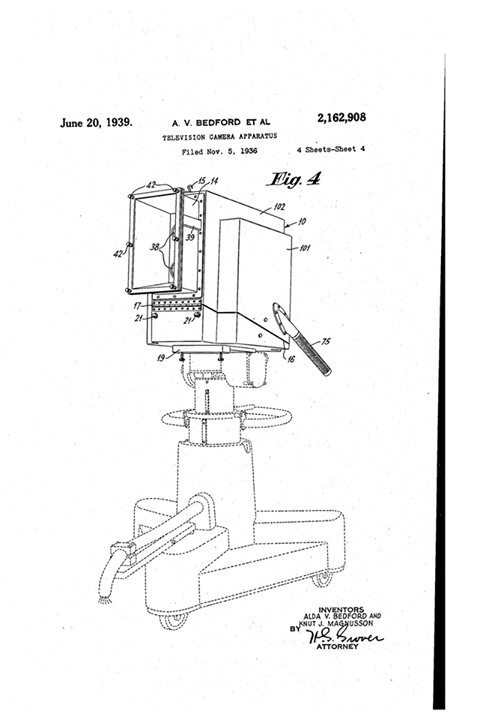
The interior view in the previous post is the most revealing of the four images, but these are also interesting. On the left, we have the view from the top, with 12 showing the focus control portion of the right rear pan handle and 21 denoting the red and green tally lights on the back. The center image shows the camera from the front with dual red and green tally lights below the lens box with red meaning on air and green meaning stand by mode. The image on the right shows the camera mounted on television’s first pedestal which will be featured tomorrow.
The 1942 GE Iconoscope Camera…Rear View
On January 14, 2014
- Archives, TV History
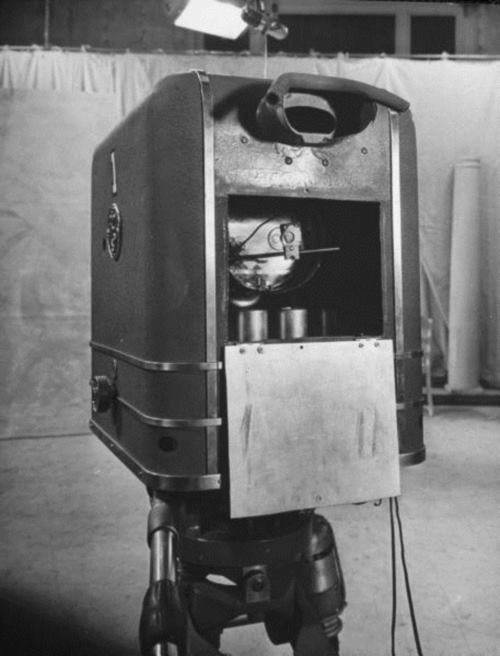
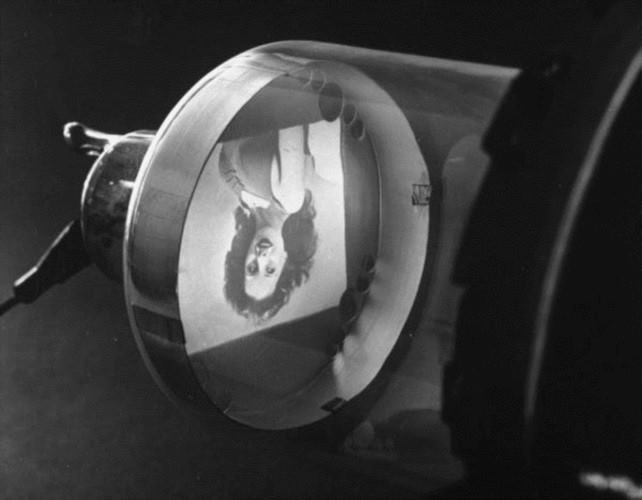
On the back side, things are a little crude on the outside, but inside…state of the art. That pitiful looking viewfinder allows the operator to see an optical image on a ground glass screen. Like the image on the Iconoscope tube (right), it is also inverted and backward meaning panning left with the camera would make the image center move to the right, tilting up would make the image center move down, and so on. On the left, you can see the rear of the Iconoscope tube but the image shown on the right could not be seen from there as the receiving surface faced the lens on the front of the camera.
The 1943 GE Iconoscope Camera…Front View
On January 14, 2014
- Archives, TV History
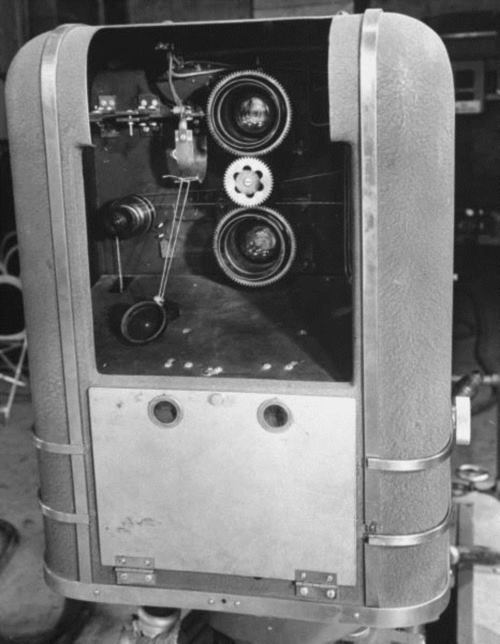
From the front, this camera and the RCA Iconoscope are quite different, yet have one thing in common. On the left is a close up of the dual lenses with the top lens feeding the optical viewfinder and the bottom lens feeding the Iconoscope tube…that is what they have in common. The big difference is that the RCA cameras could change lens sets and the GE cameras can not as they were made with what look like 90mm pairs that are permanently installed. The GE lenses are recessed and internal where the RCA lenses were front mounted and had quick change clasps for different lens sets.
‘The Dick Cavett Show’
On January 14, 2014
- TV History
‘The Dick Cavett Show’
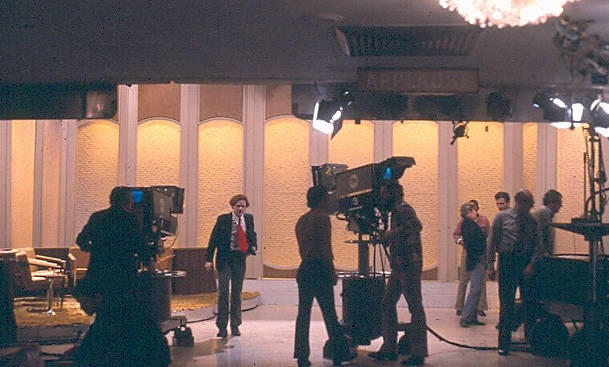
That had been the title of several shows hosted by Cavett on several networks, but his longest run and best known version was the late night show that ran against Johnny Carson from December of ’69 till January ’75. That show was done in New York from ABC TV 15 which is shown here. I think TV 15 was the only ABC stage in NY with GE color cameras. In a strange quirk, the show he replaced, ‘The Joey Bishop Show’ was done at the only place in Los Angeles that ABC used GE cameras at 1313 Vine Street. I don’t think the man in the red tie is Cavett, but it may be.
RCA TK10 “Taking Lens”
On January 13, 2014
- TV History
Take Your Best Shot
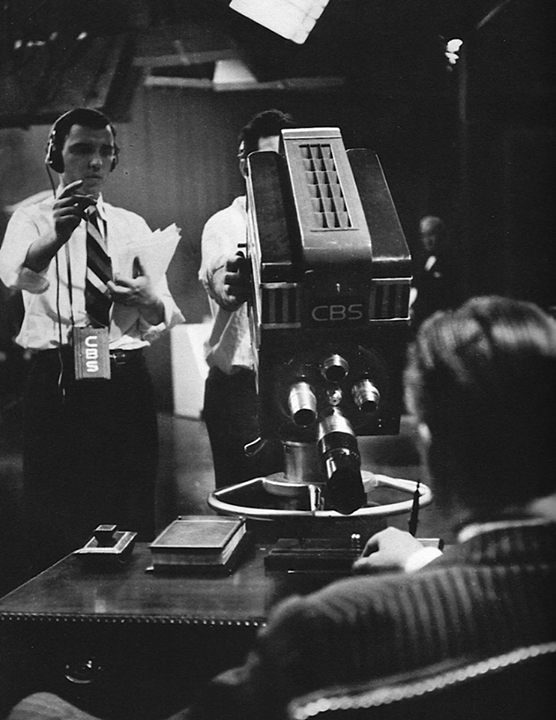
In this photo, the RCA TK10 has a wide angle opening shot of the man’s desk top and will probably tilt up to show his face. The “taking lens” is the lens in front of the IO tube which on the TK10 and TK30 was the top center position. In this photo, the camera is shooting with a 50mm lens. The middle right lens is a 90mm, at the bottom an 8 1/2 inch, and middle left is the 135mm. The longest lens must always be mounted 180 degrees away from the shortest lens (on the other side of the center nut). If not, the shorter lens will “see” the longer lens.
‘The Big Party’, CBS Studio 33, October 8, 1959
On January 13, 2014
- TV History
‘The Big Party’, CBS Studio 33, October 8, 1959
https://archive.org/details/TheBigParty1959
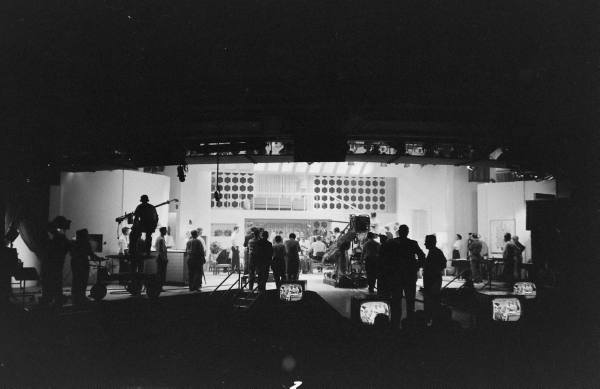
At the link is the entire 90 minute show which was the debut of this monthly program sponsored by Revlon. This still shows the half ramp installed for the Houston Fearless crane. When Television City opened, 31 and 33 had permanent camera ramps all the way from the stage to the control rooms. A few years later, the ramps were removed and more seats were installed, but now the stages had a removable “half” ramp and could be used as needed. Although there were only six episodes of ‘The Big Party’, they were packed with stars…this debut show is hosted by Rock Hudson and has over a dozen guests like Sammy Davis, Tallulah Bankhead, Ester Williams and more.
The Business End Of An RCA Camera
On January 13, 2014
- TV History
The Business End Of An RCA Camera
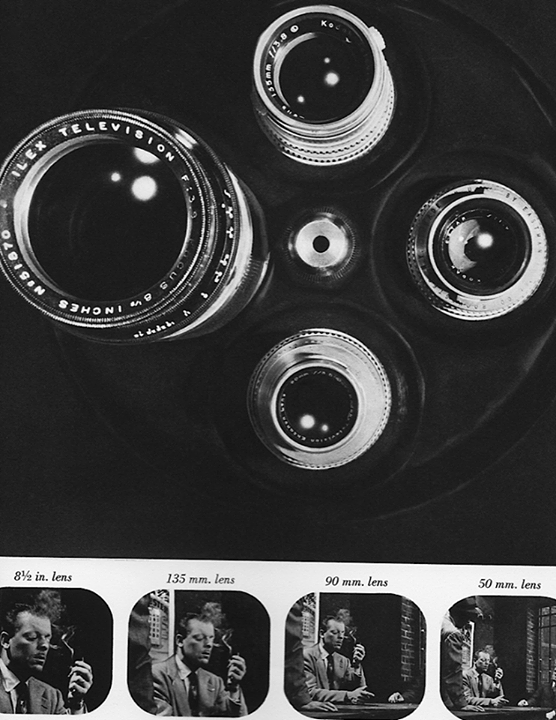
From 1946 till around 1966, most cameras around the world were four lens turrets. The most common array of lenses was the 8 1/2 inch, 135mm, 90mm and 50mm. The turret was first used on the RCA TK30s and TK10s. The last RCA with a turret was the TK60. Below is a look at the range of field these lenses offered. A the networks, on large productions, different cameras may have used different lenses for new perspectives. Lens changes during a live show was not unheard of, but was not par for the course.
Page 97 of 135
« Previous
1
2
3
4
5
6
7
8
9
10
11
12
13
14
15
16
17
18
19
20
21
22
23
24
25
26
27
28
29
30
31
32
33
34
35
36
37
38
39
40
41
42
43
44
45
46
47
48
49
50
51
52
53
54
55
56
57
58
59
60
61
62
63
64
65
66
67
68
69
70
71
72
73
74
75
76
77
78
79
80
81
82
83
84
85
86
87
88
89
90
91
92
93
94
95
96
97
98
99
100
101
102
103
104
105
106
107
108
109
110
111
112
113
114
115
116
117
118
119
120
121
122
123
124
125
126
127
128
129
130
131
132
133
134
135
Next »